In Exercises 31–50, find fg and determine the domain for each function. f(x) = √(x +4), g(x) = √(x − 1)
Ch. 2 - Functions and Graphs

3장, 문제 47d
In Exercises 31–50, find f/g and determine the domain for each function. f(x) = √(x +4), g(x) = √(x − 1)
검증된 단계별 안내1
Step 1: Understand the problem. You are tasked with finding the quotient of two functions, f(x) and g(x), which is written as (f/g)(x) = f(x)/g(x). Additionally, you need to determine the domain of this quotient function.
Step 2: Write the quotient function. Substitute the given functions into the formula: (f/g)(x) = (√(x + 4)) / (√(x − 1)).
Step 3: Determine the domain of f(x). Since f(x) = √(x + 4), the expression inside the square root, x + 4, must be greater than or equal to 0. Solve the inequality x + 4 ≥ 0 to find x ≥ -4. This means the domain of f(x) is all x such that x ≥ -4.
Step 4: Determine the domain of g(x). Since g(x) = √(x − 1), the expression inside the square root, x − 1, must also be greater than or equal to 0. Solve the inequality x − 1 ≥ 0 to find x ≥ 1. This means the domain of g(x) is all x such that x ≥ 1.
Step 5: Combine the domain restrictions. For the quotient (f/g)(x) to be defined, g(x) cannot be 0 (division by zero is undefined). Therefore, x − 1 > 0, which simplifies to x > 1. Combine this with the domain restrictions from f(x) and g(x). The final domain is all x such that x > 1.

비슷한 문제에 대한 검증된 영상 답변:
이 영상 해법은 위 문제에 도움이 된다고 튜터들이 추천한 것입니다.
영상 길이:
2m도움이 되었나요?
주요 개념
질문에 올바르게 답하기 위해 반드시 이해해야 하는 핵심 개념들은 다음과 같습니다.
Function Division
Function division involves creating a new function by dividing one function by another. In this case, f/g means we take the function f(x) and divide it by g(x). This operation requires understanding how to manipulate functions and the implications of division, particularly regarding the values that make the denominator zero.
추천 영상:
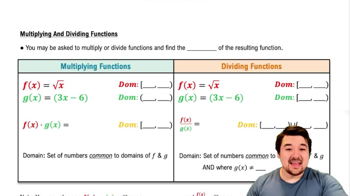
Multiplying & Dividing Functions
Domain of a Function
The domain of a function is the set of all possible input values (x-values) for which the function is defined. For square root functions, the expression inside the square root must be non-negative. Therefore, determining the domain involves solving inequalities to find the valid x-values for both f(x) and g(x).
추천 영상:
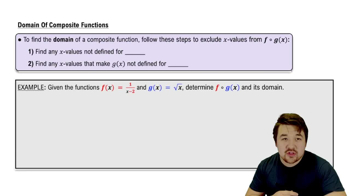
Domain Restrictions of Composed Functions
Composite Functions
Composite functions occur when one function is applied to the result of another function. In the context of f/g, we need to consider how the outputs of f and g interact, particularly focusing on the restrictions imposed by g(x) since division by zero is undefined. Understanding how to combine and analyze these functions is crucial for finding the overall domain.
추천 영상:
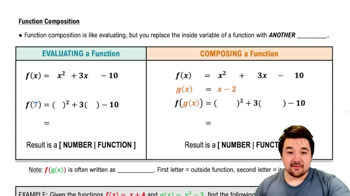
Function Composition
관련 실천
교과서 질문
909
views
교과서 질문
In Exercises 31–50, find f−g and determine the domain for each function. f(x) = √(x +4), g(x) = √(x − 1)
1228
views
교과서 질문
Use the graph of y = f(x) to graph each function g. g(x) = -f(x + 1) − 1
692
views
교과서 질문
In Exercises 41–52, give the center and radius of the circle described by the equation and graph each equation. Use the graph to identify the relation's domain and range. x² + (y − 1)² = 1
956
views
교과서 질문
In Exercises 46–49, give the slope and y-intercept of each line whose equation is given. Then graph the line. 2x + 3y + 6 = 0
1444
views
교과서 질문
In Exercises 39-52, a. Find an equation for ƒ¯¹(x). b. Graph ƒ and ƒ¯¹(x) in the same rectangular coordinate system. c. Use interval notation to give the domain and the range off and ƒ¯¹. f(x) = (x+2)³
617
views