Ch. 2 - Functions and Graphs
Blitzer - College Algebra 8th Edition
Blitzer8th EditionCollege AlgebraISBN: 9780136970514당신이 사용하는 게 아니라요?교과서 변경
3장, 문제 47c

In Exercises 31–50, find fg and determine the domain for each function. f(x) = √(x +4), g(x) = √(x − 1)

검증된 단계별 안내
1
Step 1: Understand the problem. The goal is to find the composition of the two functions, fg(x), which means f(g(x)). This involves substituting g(x) into f(x). Additionally, we need to determine the domain of the resulting function.
Step 2: Substitute g(x) into f(x). Since f(x) = √(x + 4) and g(x) = √(x − 1), replace x in f(x) with g(x). This gives fg(x) = √(g(x) + 4). Substituting g(x), we get fg(x) = √(√(x − 1) + 4).
Step 3: Simplify the expression if possible. In this case, the expression fg(x) = √(√(x − 1) + 4) cannot be simplified further.
Step 4: Determine the domain of fg(x). The domain of a square root function is restricted to values where the expression inside the square root is non-negative. Start by ensuring the inner square root, √(x − 1), is defined. This requires x − 1 ≥ 0, so x ≥ 1. Next, ensure the entire expression √(√(x − 1) + 4) is defined. Since √(x − 1) + 4 is always non-negative for x ≥ 1, no additional restrictions are needed.
Step 5: Combine the domain restrictions. The domain of fg(x) is x ≥ 1. In interval notation, this is [1, ∞).

비슷한 문제에 대한 검증된 영상 답변:

이 영상 해법은 위 문제에 도움이 된다고 튜터들이 추천한 것입니다.
영상 길이:
4m
도움이 되었나요?

주요 개념

질문에 올바르게 답하기 위해 반드시 이해해야 하는 핵심 개념들은 다음과 같습니다.

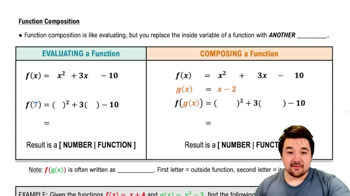
Function Composition

Function composition involves combining two functions, where the output of one function becomes the input of another. In this case, fg means f(g(x)), which requires evaluating g(x) first and then substituting that result into f(x). Understanding how to properly compose functions is essential for solving the problem.
추천 영상:
4:56
Function Composition

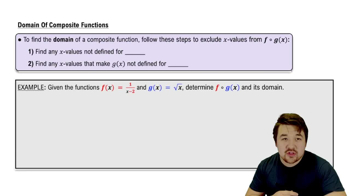
Domain of a Function

The domain of a function is the set of all possible input values (x-values) for which the function is defined. For functions involving square roots, the expression inside the root must be non-negative. Therefore, determining the domain involves solving inequalities to find valid x-values for both f(x) and g(x).
추천 영상:
3:51
Domain Restrictions of Composed Functions

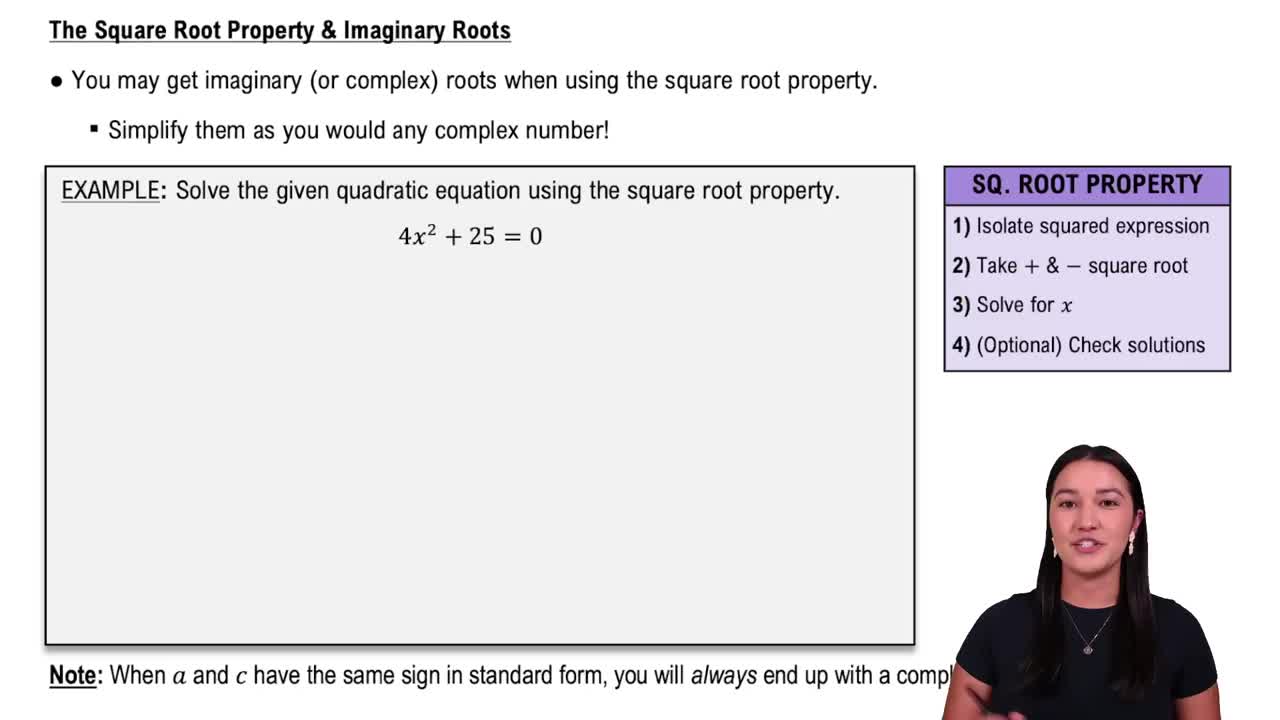
Square Root Functions

Square root functions, such as f(x) = √(x + 4) and g(x) = √(x - 1), are defined only for non-negative inputs. This means that the expressions under the square roots must be greater than or equal to zero. Understanding the behavior and restrictions of square root functions is crucial for finding their domains and composing them correctly.
추천 영상:
02:20
Imaginary Roots with the Square Root Property