Referring to Figure 11.29, describe the phase changes (and the temperatures at which they occur) when CO2 is heated from -80 to -20°C at (a) a constant pressure of 3 atm,
Ch.11 - Liquids and Intermolecular Forces
11장, 문제 62a
Use the phase diagram of neon to answer the following questions. (a) What is the approximate value of the normal boiling point?
검증된 단계별 안내1
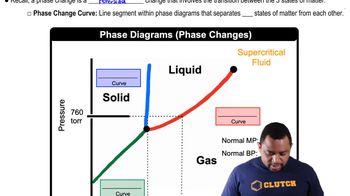
Understand the concept of a phase diagram: A phase diagram is a graphical representation of the physical states of a substance under different conditions of temperature and pressure. It typically includes lines that separate different phases such as solid, liquid, and gas.
Identify the normal boiling point: The normal boiling point is the temperature at which a substance transitions from liquid to gas at 1 atmosphere of pressure.
Locate the phase diagram for neon: You will need to refer to a phase diagram specific to neon, which shows the relationship between temperature and pressure for its different phases.
Find the point on the phase diagram where the liquid-gas boundary intersects with the line representing 1 atmosphere of pressure. This intersection point indicates the normal boiling point of neon.
Read the temperature value at this intersection: The temperature at this point on the phase diagram is the approximate value of the normal boiling point of neon.

비슷한 문제에 대한 검증된 영상 답변:
이 영상 해법은 위 문제에 도움이 된다고 튜터들이 추천한 것입니다.
영상 길이:
2m주요 개념
질문에 올바르게 답하기 위해 반드시 이해해야 하는 핵심 개념들은 다음과 같습니다.
Phase Diagram
A phase diagram is a graphical representation that shows the states of a substance (solid, liquid, gas) at various temperatures and pressures. It helps in understanding the conditions under which a substance will exist in different phases and indicates critical points, such as the boiling point and melting point.
추천 영상:
가이드 코스
Phase Changes in Diagrams
Normal Boiling Point
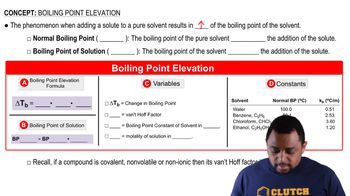
The normal boiling point of a substance is the temperature at which it transitions from a liquid to a gas at a pressure of 1 atmosphere (atm). This value is significant as it provides insight into the substance's volatility and intermolecular forces, with lower boiling points indicating weaker forces.
추천 영상:
가이드 코스
Boiling Point Elevation
Intermolecular Forces
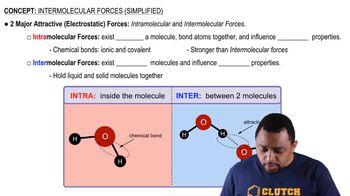
Intermolecular forces are the forces of attraction or repulsion between molecules. They play a crucial role in determining the physical properties of substances, including boiling and melting points. In the case of neon, a noble gas, the weak London dispersion forces influence its phase transitions.
추천 영상:
가이드 코스
Intermolecular vs Intramolecular Forces
관련 실천
교과서 질문
1224
views
교과서 질문
(b) Could you measure the triple point of water by measuring the temperature in a vessel in which water vapor, liquid water, and ice are in equilibrium under 1 atm of air? Explain.
690
views
교과서 질문
Use the phase diagram of neon to answer the following questions. (b) What can you say about the strength of the intermolecular forces in neon and argon based on the critical points of Ne and Ar (see Table 11.5.)?
687
views
교과서 질문
At 25 °C gallium is a solid with a density of 5.91 g/cm3. Its melting point, 29.8 °C, is low enough that you can melt it by holding it in your hand. The density of liquid gallium just above the melting point is 6.1 g/cm3. Based on this information, what unusual feature would you expect to find in the phase diagram of gallium?
1214
views
교과서 질문
The phase diagram for neon is
Use the phase diagram to answer the following questions. (a) What is the approximate value of the normal melting point?
1268
views