Ch.11 - Liquids and Intermolecular Forces
Brown - Chemistry: The Central Science 14th Edition
Brown14th EditionChemistry: The Central ScienceISBN: 9780134414232당신이 사용하는 게 아니라요?교과서 변경
11장, 문제 81

Use the normal boiling points propane (C3H8) -42.1 °C butane (C4H10) -0.5 °C pentane (C5H12) 36.1 °C hexane (C6H14) 68.7 °C heptane (C7H16) 98.4 °C to estimate the normal boiling point of octane (C8H18). Explain the trend in the boiling points.

검증된 단계별 안내
1
Identify the trend in boiling points as the number of carbon atoms in the alkane increases. Notice that as the carbon chain lengthens from propane (C3H8) to heptane (C7H16), the boiling point rises.
Plot the given data points (number of carbons vs. boiling points) on a graph to visually assess the trend. This can help in predicting the boiling point for octane (C8H18).
Apply a method of linear extrapolation using the boiling points of the closest known higher hydrocarbons, such as hexane, heptane, and possibly pentane, to estimate the boiling point of octane.
Calculate the average increase in boiling point per additional carbon atom based on the data from the known alkanes. Use this average increase to estimate the boiling point of octane by adding this value to the boiling point of heptane.
Consider the molecular interactions and structural implications. As the molecular weight and surface area of the molecules increase, the London dispersion forces become stronger, leading to higher boiling points. This understanding supports the trend observed and the extrapolation made for octane.

비슷한 문제에 대한 검증된 영상 답변:

이 영상 해법은 위 문제에 도움이 된다고 튜터들이 추천한 것입니다.
영상 길이:
1m
도움이 되었나요?

주요 개념

질문에 올바르게 답하기 위해 반드시 이해해야 하는 핵심 개념들은 다음과 같습니다.

Boiling Point and Intermolecular Forces

The boiling point of a substance is the temperature at which its vapor pressure equals the atmospheric pressure, allowing it to transition from liquid to gas. This property is significantly influenced by intermolecular forces, such as van der Waals forces, which increase with molecular size and surface area. As the molecular weight of hydrocarbons increases, so do the London dispersion forces, leading to higher boiling points.
추천 영상:
가이드 코스
01:59
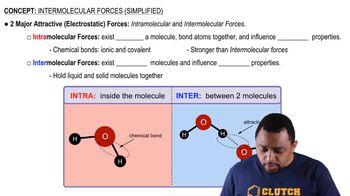
Intermolecular vs Intramolecular Forces

Hydrocarbon Structure and Molecular Weight

Hydrocarbons are organic compounds consisting solely of hydrogen and carbon. The structure of these molecules, including the number of carbon atoms, directly affects their physical properties. As the number of carbon atoms increases, the molecular weight also increases, which typically results in stronger intermolecular forces and higher boiling points, as seen in the provided data for propane, butane, pentane, hexane, and heptane.
추천 영상:
가이드 코스
04:29
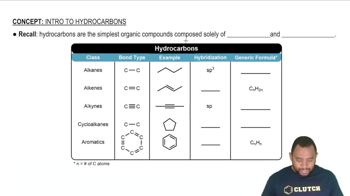
Intro To Hydrocarbons

Trends in Boiling Points of Alkanes

In a series of straight-chain alkanes, the boiling points generally increase with the number of carbon atoms. This trend can be attributed to the increasing surface area and the resultant increase in van der Waals forces. For octane (C8H18), one can estimate its boiling point by observing the pattern in the boiling points of the preceding alkanes, suggesting it will be higher than that of heptane (98.4 °C) due to its larger molecular size.
추천 영상:
가이드 코스
03:05
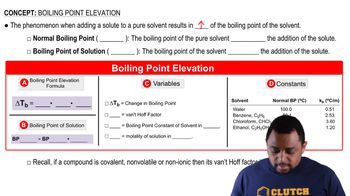
Boiling Point Elevation