
Ch.14 - Chemical Kinetics
Brown - Chemistry: The Central Science 14th Edition
Brown14th EditionChemistry: The Central ScienceISBN: 9780134414232당신이 사용하는 게 아니라요?교과서 변경
14장, 문제 74

(c) What are the intermediates in this mechanism? (d) If you are unable to detect HOBr or HOOBr among the products, does this disprove your mechanism?

검증된 단계별 안내
1
Step 1: Understand the concept of reaction intermediates. Intermediates are species that are formed during the reaction process but do not appear in the overall balanced equation. They are typically unstable and short-lived.
Step 2: Analyze the given mechanism to identify intermediates. Look for species that are produced in one step and consumed in another, without appearing in the final products.
Step 3: Consider the role of HOBr and HOOBr in the mechanism. If these species are formed and consumed within the reaction steps, they are likely intermediates.
Step 4: Evaluate the significance of detecting intermediates. The inability to detect HOBr or HOOBr among the products does not necessarily disprove the mechanism, as intermediates are often transient and may not be present in measurable quantities at the end of the reaction.
Step 5: Consider alternative methods to support the mechanism. Even if intermediates are not directly detected, other evidence such as kinetic studies or indirect observations can support the proposed mechanism.

주요 개념

질문에 올바르게 답하기 위해 반드시 이해해야 하는 핵심 개념들은 다음과 같습니다.

Reaction Intermediates

Reaction intermediates are species that are formed during the course of a chemical reaction but are not present in the final products. They are typically unstable and exist only for a short duration. Understanding intermediates is crucial for elucidating the mechanism of a reaction, as they provide insight into the steps and transitions that occur from reactants to products.
추천 영상:
가이드 코스
02:14
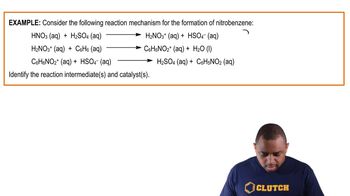
Reaction Mechanism Example

Mechanism of a Reaction

The mechanism of a reaction describes the step-by-step sequence of elementary reactions by which overall chemical change occurs. It includes details about the formation and consumption of intermediates, the transition states, and the energy changes involved. A clear understanding of the mechanism helps predict the products and the conditions under which the reaction occurs.
추천 영상:
가이드 코스
03:06
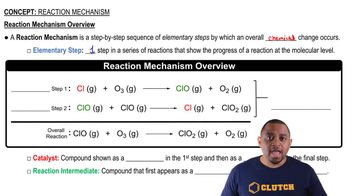
Reaction Mechanism Overview

Detection of Reaction Products

The detection of reaction products is essential for validating a proposed reaction mechanism. If expected products, such as HOBr or HOOBr, are not detected, it raises questions about the accuracy of the mechanism. However, the absence of certain products does not necessarily disprove the mechanism, as intermediates may not be stable enough to be isolated or detected under the reaction conditions.
추천 영상:
가이드 코스
01:30
Production of Hydrogen Example
관련 실천
교과서 질문

The reaction 2 NO1g2 + Cl21g2¡2 NOCl1g2 was performed and the following data were obtained under conditions of constant 3Cl24:

(a) Is the following mechanism consistent with the data? NO1g2 + Cl21g2ΔNOCl21g2 1fast2 NOCl21g2 + NO1g2¡2 NOCl1g2 1slow2

292
views
교과서 질문

You have studied the gas-phase oxidation of HBr by O2: 4 HBr(g) + O2(g) → 2 H2O(g) + 2 Br2(g)

You find the reaction to be first order with respect to HBr and first order with respect to O2. You propose the following mechanism:

HBr(g) + O2(g) → HOOBr(g)

HOOBr(g) + HBr(g) → 2 HOBr(g)

HOBr(g) + HBr(g) → H2O(g) + Br2(g)

(a) Confirm that the elementary reactions add to give the overall reaction.

346
views
교과서 질문

The decomposition of hydrogen peroxide is catalyzed by iodide ion. The catalyzed reaction is thought to proceed by a two-step mechanism:

H2O2(aq) + I-(aq) → H2O(l) + IO-(aq) (slow)

IO-(aq) + H2O2(aq) → H2O(l) + O2(g) + I-(aq) (fast)

(c) Assuming that the first step of the mechanism is rate determining, predict the rate law for the overall process.

1669
views
교과서 질문

(a) What is a catalyst? (b) What is the difference between a homogeneous and a heterogeneous catalyst?

교과서 질문

The decomposition of hydrogen peroxide is catalyzed by iodide ion. The catalyzed reaction is thought to proceed by a two-step mechanism:

H2O2(aq) + I-(aq) → H2O(l) + IO-(aq) (slow)

IO-(aq) + H2O2(aq) → H2O(l) + O2(g) + I-(aq) (fast)

(b) Identify the intermediate, if any, in the mechanism.

1697
views
교과서 질문

You have studied the gas-phase oxidation of HBr by O2: 4 HBr(g) + O2(g) → 2 H2O(g) + 2 Br2(g)

You find the reaction to be first order with respect to HBr and first order with respect to O2. You propose the following mechanism:

HBr(g) + O2(g) → HOOBr(g)

HOOBr(g) + HBr(g) → 2 HOBr(g)

HOBr(g) + HBr(g) → H2O(g) + Br2(g)

(b) Based on the experimentally determined rate law, which step is rate determining?

1025
views