Ch.18 - Chemistry of the Environment
Brown - Chemistry: The Central Science 14th Edition
Brown14th EditionChemistry: The Central ScienceISBN: 9780134414232당신이 사용하는 게 아니라요?교과서 변경
18장, 문제 23

Do the reactions involved in ozone depletion involve changes in the oxidation state of the O atoms? Explain.

검증된 단계별 안내
1
Step 1: Understand the basic chemistry of ozone (O₃) in the stratosphere. Ozone is a molecule composed of three oxygen atoms and plays a crucial role in absorbing harmful ultraviolet radiation from the sun.
Step 2: Identify the key reactions involved in ozone depletion. The primary reactions involve the interaction of ozone with chlorine and bromine compounds, which are often released from chlorofluorocarbons (CFCs) and halons.
Step 3: Examine the reaction mechanism. A typical reaction involves a chlorine atom (Cl) reacting with an ozone molecule (O₃) to form chlorine monoxide (ClO) and oxygen (O₂). The ClO can further react with another ozone molecule to regenerate the chlorine atom and produce more oxygen.
Step 4: Analyze the oxidation states of oxygen in these reactions. In ozone (O₃), the oxidation state of each oxygen atom is 0. When ozone decomposes into molecular oxygen (O₂), the oxidation state of oxygen remains 0. Therefore, there is no change in the oxidation state of oxygen atoms during these reactions.
Step 5: Conclude that while ozone depletion involves chemical reactions, the oxidation state of oxygen atoms does not change. The process is more about the conversion between different forms of oxygen (O₃ to O₂) rather than a change in oxidation state.

주요 개념

질문에 올바르게 답하기 위해 반드시 이해해야 하는 핵심 개념들은 다음과 같습니다.

Ozone Depletion

Ozone depletion refers to the reduction of ozone (O3) in the stratosphere, primarily caused by human-made chemicals like chlorofluorocarbons (CFCs). These substances release chlorine atoms upon exposure to ultraviolet (UV) radiation, which catalyze the breakdown of ozone molecules into oxygen (O2), leading to a thinner ozone layer that allows more UV radiation to reach the Earth's surface.
추천 영상:
가이드 코스
00:46
Formation Equations Example 1

Oxidation State

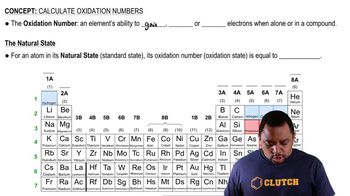
The oxidation state, or oxidation number, is a measure of the degree of oxidation of an atom in a chemical compound. It indicates the number of electrons an atom has gained, lost, or shared when forming a compound. In the context of ozone depletion, understanding the oxidation states of oxygen in O3 and O2 is crucial to analyze the chemical transformations occurring during the reactions.
추천 영상:
가이드 코스
02:42
Oxidation Numbers

Redox Reactions

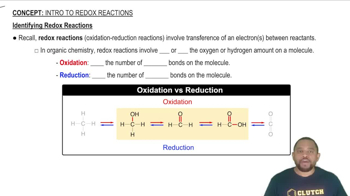
Redox reactions, or reduction-oxidation reactions, involve the transfer of electrons between species, resulting in changes in their oxidation states. In the case of ozone depletion, the reactions can be classified as redox processes where chlorine atoms are reduced (gaining electrons) while ozone is oxidized (losing electrons), leading to a change in the oxidation states of the involved oxygen atoms.
추천 영상:
가이드 코스
03:12
Identifying Redox Reactions