A voltaic cell utilizes the following reaction: Al1s2 + 3 Ag+1aq2 ¡ Al3+1aq2 + 3 Ag1s2 What is the effect on the cell emf of each of the following changes? (a) Water is added to the anode half-cell, diluting the solution.
Ch.20 - Electrochemistry
20장, 문제 61
(a) In the Nernst equation, what is the numerical value of the reaction quotient, Q, under standard conditions? (b) Can the Nernst equation be used at temperatures other than room temperature?
검증된 단계별 안내1
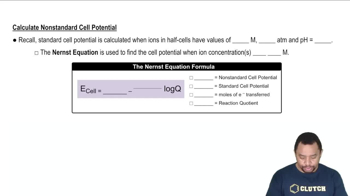
Step 1: Understand the Nernst equation, which is given by: E = E^0 - (RT/nF) * ln(Q), where E is the cell potential, E^0 is the standard cell potential, R is the universal gas constant, T is the temperature in Kelvin, n is the number of moles of electrons transferred, F is Faraday's constant, and Q is the reaction quotient.
Step 2: For part (a), recognize that under standard conditions, the reaction quotient Q is equal to 1. This is because standard conditions imply that all reactants and products are in their standard states, typically 1 M concentration for solutions or 1 atm pressure for gases.
Step 3: Substitute Q = 1 into the Nernst equation. Since ln(1) = 0, the term (RT/nF) * ln(Q) becomes zero, simplifying the equation to E = E^0 under standard conditions.
Step 4: For part (b), consider the applicability of the Nernst equation at different temperatures. The Nernst equation can indeed be used at temperatures other than room temperature, but the temperature T in the equation must be adjusted to reflect the actual temperature in Kelvin.
Step 5: To use the Nernst equation at a temperature other than room temperature, ensure that the value of T is correctly converted to Kelvin by adding 273.15 to the Celsius temperature, and adjust the equation accordingly.
주요 개념
질문에 올바르게 답하기 위해 반드시 이해해야 하는 핵심 개념들은 다음과 같습니다.
Nernst Equation
The Nernst equation relates the cell potential of an electrochemical reaction to the concentrations of the reactants and products. It is expressed as E = E° - (RT/nF) ln(Q), where E° is the standard cell potential, R is the gas constant, T is the temperature in Kelvin, n is the number of moles of electrons transferred, F is Faraday's constant, and Q is the reaction quotient.
추천 영상:
가이드 코스
The Nernst Equation
Reaction Quotient (Q)
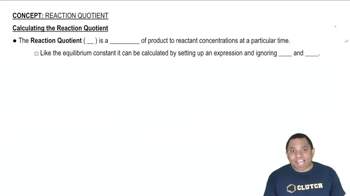
The reaction quotient, Q, is a measure of the relative concentrations of products and reactants at any point in a reaction. Under standard conditions, Q is calculated using the standard concentrations (1 M for solutions) of the reactants and products. For a general reaction aA + bB ⇌ cC + dD, Q is given by Q = [C]^c[D]^d / [A]^a[B]^b.
추천 영상:
가이드 코스
Reaction Quotient Q
Standard Conditions
Standard conditions typically refer to a temperature of 25°C (298 K), a pressure of 1 atm, and concentrations of 1 M for all reactants and products. Under these conditions, the standard cell potential (E°) is defined, and the reaction quotient (Q) simplifies to a specific value, allowing for easier calculations in electrochemistry.
추천 영상:
가이드 코스
Standard Reduction Potentials
관련 실천
교과서 질문
836
views
교과서 질문
At 298 K a cell reaction has a standard cell potential of +0.17 V. The equilibrium constant for the reaction is 5.5 × 10⁵. What is the value of n for the reaction?
103
views
교과서 질문
A voltaic cell is constructed that uses the following reaction and operates at 298 K: Zn(s) + Ni2+(aq) → Zn2+(aq) + Ni(s) (b) What is the emf of this cell when [Ni2+] = 3.00 M and [Zn2+] = 0.100 M? (c) What is the emf of the cell when [Ni2+] = 0.200 M and [Zn2+] = 0.900 M?
850
views
교과서 질문
A cell has a standard cell potential of +0.177 V at 298 K. What is the value of the equilibrium constant for the reaction (b) if n = 2? (c) if n = 3?
818
views
1
rank