Ch.20 - Electrochemistry
Brown - Chemistry: The Central Science 14th Edition
Brown14th EditionChemistry: The Central ScienceISBN: 9780134414232당신이 사용하는 게 아니라요?교과서 변경
20장, 문제 59

A voltaic cell is based on the reaction Sn(s) + I2(s) → Sn2+(aq) + 2 I-(aq). Under standard conditions, what is the maximum electrical work, in joules, that the cell can accomplish if 75.0 g of Sn is consumed?

검증된 단계별 안내
1
Step 1: Determine the molar mass of Sn (tin) from the periodic table. Tin has a molar mass of approximately 118.71 g/mol.
Step 2: Calculate the number of moles of Sn consumed using the formula: \( \text{moles of Sn} = \frac{\text{mass of Sn}}{\text{molar mass of Sn}} \). Substitute the given mass of Sn (75.0 g) and the molar mass from Step 1.
Step 3: Identify the number of electrons transferred in the balanced redox reaction. The reaction shows that each Sn atom loses 2 electrons to form Sn\(^{2+}\).
Step 4: Calculate the total charge transferred using the formula: \( \text{total charge (C)} = \text{moles of electrons} \times \text{Faraday's constant (96485 C/mol)} \). The moles of electrons are twice the moles of Sn from Step 2.
Step 5: Use the Nernst equation to find the standard cell potential (E°) for the reaction, and then calculate the maximum electrical work using the formula: \( \text{maximum work (J)} = -nFE° \), where \( n \) is the number of moles of electrons and \( F \) is Faraday's constant.

주요 개념

질문에 올바르게 답하기 위해 반드시 이해해야 하는 핵심 개념들은 다음과 같습니다.

Voltaic Cell

A voltaic cell, also known as a galvanic cell, is an electrochemical cell that converts chemical energy from spontaneous redox reactions into electrical energy. It consists of two half-cells, each containing an electrode and an electrolyte, where oxidation occurs at the anode and reduction at the cathode. The flow of electrons from the anode to the cathode generates an electric current, which can be harnessed for work.
추천 영상:
가이드 코스
01:21
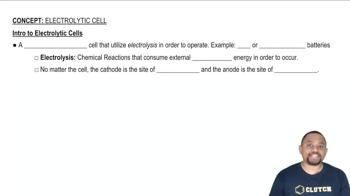
The Electrolytic Cell

Standard Conditions

Standard conditions refer to a set of specific conditions used to measure and compare the properties of chemical reactions, typically defined as 1 bar of pressure and a temperature of 25°C (298 K). Under these conditions, the standard electrode potentials can be determined, which are essential for calculating the maximum electrical work a voltaic cell can perform. These values help predict the feasibility and extent of the redox reactions involved.
추천 영상:
가이드 코스
01:10
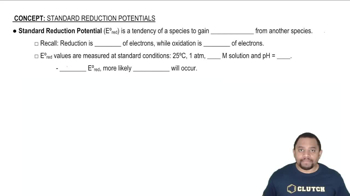
Standard Reduction Potentials

Maximum Electrical Work

The maximum electrical work that a voltaic cell can perform is directly related to the Gibbs free energy change (ΔG) of the reaction. It can be calculated using the equation ΔG = -nFE, where n is the number of moles of electrons transferred, F is Faraday's constant (approximately 96485 C/mol), and E is the cell potential under standard conditions. This relationship highlights the efficiency of the cell in converting chemical energy into electrical energy.
추천 영상:
가이드 코스
01:52
Work Function Calculation Example