Ch.21 - Nuclear Chemistry
Brown - Chemistry: The Central Science 14th Edition
Brown14th EditionChemistry: The Central ScienceISBN: 9780134414232당신이 사용하는 게 아니라요?교과서 변경
21장, 문제 29

Complete and balance the following nuclear equations by supplying the missing particle: (a) 25298Cf + 105B → 310n + ? (c) 11H + 115B → ?

검증된 단계별 안내
1
Step 1: Understand the concept of nuclear reactions. In nuclear reactions, the sum of the atomic numbers and the sum of the mass numbers must be equal on both sides of the equation.
Step 2: For part (a), identify the known particles in the equation: Californium-252 (\(^{252}_{98}\text{Cf}\)), Boron-10 (\(^{10}_{5}\text{B}\)), and three neutrons (\(3\times ^{1}_{0}\text{n}\)).
Step 3: Calculate the total atomic number and mass number on the left side of the equation: Atomic number = 98 + 5 = 103, Mass number = 252 + 10 = 262.
Step 4: Calculate the total atomic number and mass number contributed by the neutrons on the right side: Atomic number = 0, Mass number = 3.
Step 5: Determine the missing particle for part (a) by ensuring the atomic and mass numbers balance: The missing particle must have an atomic number of 103 and a mass number of 259. For part (c), follow similar steps to balance the equation using the given particles: Hydrogen-1 (\(^{1}_{1}\text{H}\)) and Boron-11 (\(^{11}_{5}\text{B}\)).

주요 개념

질문에 올바르게 답하기 위해 반드시 이해해야 하는 핵심 개념들은 다음과 같습니다.

Nuclear Reactions

Nuclear reactions involve changes in an atom's nucleus and can result in the transformation of elements. They typically include processes such as fusion, fission, and radioactive decay. Understanding the conservation of mass and charge is crucial, as the total number of nucleons and the charge must remain constant before and after the reaction.
추천 영상:
가이드 코스
02:06
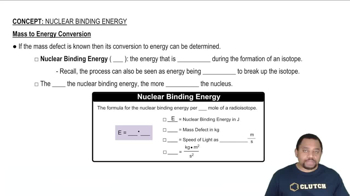
Nuclear Binding Energy

Balancing Nuclear Equations

Balancing nuclear equations requires ensuring that both the mass number (total number of protons and neutrons) and the atomic number (number of protons) are conserved. This means that the sum of the mass numbers and the sum of the atomic numbers on the reactant side must equal those on the product side. Identifying missing particles often involves using known isotopes and their properties.
추천 영상:
가이드 코스
01:32
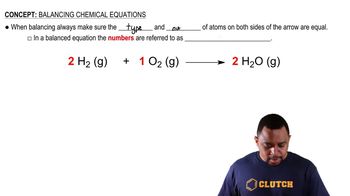
Balancing Chemical Equations

Types of Particles in Nuclear Reactions

In nuclear reactions, various particles can be involved, including neutrons, protons, alpha particles, and beta particles. Each particle has specific properties, such as mass and charge, which influence the outcome of the reaction. Recognizing these particles and their roles is essential for accurately completing and balancing nuclear equations.
추천 영상:
가이드 코스
05:19
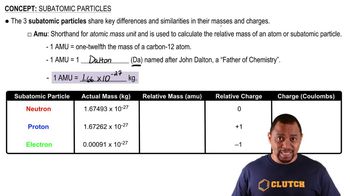
Subatomic Particles