Ch.21 - Nuclear Chemistry
Brown - Chemistry: The Central Science 14th Edition
Brown14th EditionChemistry: The Central ScienceISBN: 9780134414232당신이 사용하는 게 아니라요?교과서 변경
21장, 문제 28

In 1930, the American physicist Ernest Lawrence designed the first cyclotron in Berkeley, California. In 1937, Lawrence bombarded a molybdenum target with deuterium ions, producing for the first time an element not found in nature. What was this element? Starting with molybdenum-96 as your reactant, write a nuclear equation to represent this process.

검증된 단계별 안내
1
Identify the reactants and products in the nuclear reaction. The reactants are molybdenum-96 (Mo-96) and deuterium (a deuterium ion is a hydrogen isotope with one proton and one neutron, represented as ^2_1H).
Determine the atomic and mass numbers for the reactants. Molybdenum-96 has an atomic number of 42 and a mass number of 96. Deuterium has an atomic number of 1 and a mass number of 2.
Write the nuclear equation by adding the atomic and mass numbers of the reactants to find the atomic and mass numbers of the product. The sum of the atomic numbers on the left side should equal the atomic number on the right side, and the same applies to the mass numbers.
Calculate the atomic number of the product: 42 (Mo) + 1 (H) = 43. Calculate the mass number of the product: 96 (Mo) + 2 (H) = 98.
Identify the element with atomic number 43, which is technetium (Tc). The nuclear equation is: ^96_42Mo + ^2_1H → ^98_43Tc.

주요 개념

질문에 올바르게 답하기 위해 반드시 이해해야 하는 핵심 개념들은 다음과 같습니다.

Nuclear Reactions

Nuclear reactions involve changes in an atom's nucleus, resulting in the transformation of elements. In these reactions, particles such as protons, neutrons, or ions collide with target nuclei, leading to the emission of radiation or the creation of new elements. Understanding the basics of nuclear reactions is essential for writing nuclear equations and predicting the products formed.
추천 영상:
가이드 코스
02:06
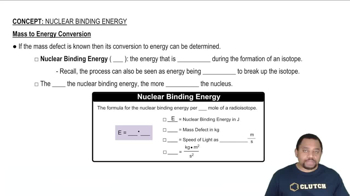
Nuclear Binding Energy

Cyclotron

A cyclotron is a type of particle accelerator that uses a magnetic field to accelerate charged particles, such as ions, to high energies. This technology allows for the bombardment of target materials, facilitating nuclear reactions that can produce new elements. The design and function of cyclotrons are crucial for understanding how certain elements can be synthesized in a laboratory setting.

Nuclear Equation

A nuclear equation represents the transformation of reactants into products during a nuclear reaction, showing the atomic numbers and mass numbers of the involved particles. It is essential to balance these equations to ensure that the conservation of mass and charge is maintained. Writing a nuclear equation for the reaction involving molybdenum-96 and deuterium ions is key to identifying the new element produced.
추천 영상:
가이드 코스
02:06
Nuclear Binding Energy