Ch.5 - Thermochemistry
Brown - Chemistry: The Central Science 14th Edition
Brown14th EditionChemistry: The Central ScienceISBN: 9780134414232당신이 사용하는 게 아니라요?교과서 변경
5장, 문제 50a

Two solid objects, A and B, are placed in boiling water and allowed to come to the temperature of the water. Each is then lifted out and placed in separate beakers containing 1000 g of water at 10.0 °C. Object A increases the water temperature by 3.50 °C; B increases the water temperature by 2.60 °C. (a) Which object has the larger heat capacity?

검증된 단계별 안내
1
Identify the heat gained by the water in each beaker using the formula: \(q = m \cdot c \cdot \Delta T\), where \(m\) is the mass of the water, \(c\) is the specific heat capacity of water (approximately 4.18 J/g°C), and \(\Delta T\) is the change in temperature of the water.
Assume that the heat lost by each object is equal to the heat gained by the water in its respective beaker, as per the law of conservation of energy.
Calculate the heat capacity of each object using the formula: \(C = \frac{q}{\Delta T}\), where \(q\) is the heat lost by the object and \(\Delta T\) is the change in temperature of the object, which is the difference between the boiling point of water and the final temperature of the water in the beaker.
Compare the heat capacities of objects A and B. The object with the larger heat capacity will have absorbed and then released more heat for the same change in temperature.
Conclude which object has the larger heat capacity based on the calculations from the previous steps.

비슷한 문제에 대한 검증된 영상 답변:

이 영상 해법은 위 문제에 도움이 된다고 튜터들이 추천한 것입니다.
영상 길이:
3m
도움이 되었나요?

주요 개념

질문에 올바르게 답하기 위해 반드시 이해해야 하는 핵심 개념들은 다음과 같습니다.

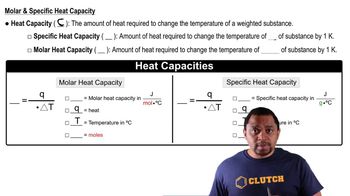
Heat Capacity

Heat capacity is the amount of heat energy required to raise the temperature of a substance by one degree Celsius. It is an extensive property, meaning it depends on the mass of the substance. In this scenario, the heat capacity of each object can be inferred from the temperature change they induce in the water, as a larger temperature change indicates a higher heat capacity.
추천 영상:

Specific Heat Capacity

Specific heat capacity is the heat capacity per unit mass of a material, indicating how much heat is needed to raise the temperature of one gram of the substance by one degree Celsius. It is a crucial concept for comparing the thermal properties of different materials. In this question, the specific heat capacities of objects A and B can be indirectly assessed by observing how much they raise the temperature of the water.
추천 영상:

Heat Transfer

Heat transfer refers to the movement of thermal energy from one object to another due to a temperature difference. In this case, when objects A and B are placed in water, they transfer heat to the water until thermal equilibrium is reached. The amount of heat transferred can be calculated using the formula Q = mcΔT, where Q is the heat transferred, m is the mass of the water, c is the specific heat capacity, and ΔT is the change in temperature.
추천 영상: