
Ch.7 - Periodic Properties of the Elements
Brown - Chemistry: The Central Science 14th Edition
Brown14th EditionChemistry: The Central ScienceISBN: 9780134414232당신이 사용하는 게 아니라요?교과서 변경
7장, 문제 21a

Tungsten has the highest melting point of any metal in the periodic table: 3422 °C. The distance between W atoms in tungsten metal is 274 pm. (a) What is the atomic radius of a tungsten atom in this environment? (This radius is called the metallic radius.)

검증된 단계별 안내
1
Start by understanding that in a metallic crystal structure, atoms are arranged in a lattice, and the distance between the centers of two adjacent atoms is twice the atomic radius.
Given that the distance between tungsten atoms is 274 pm, recognize that this distance is the diameter of the atom in the metallic structure.
To find the atomic radius, divide the given distance by 2, since the atomic radius is half of the distance between the centers of two adjacent atoms.
Use the formula: \( \text{Atomic Radius} = \frac{\text{Distance between atoms}}{2} \).
Substitute the given distance (274 pm) into the formula to find the atomic radius.

비슷한 문제에 대한 검증된 영상 답변:

이 영상 해법은 위 문제에 도움이 된다고 튜터들이 추천한 것입니다.
영상 길이:
2m

주요 개념

질문에 올바르게 답하기 위해 반드시 이해해야 하는 핵심 개념들은 다음과 같습니다.

Metallic Radius

The metallic radius is defined as half the distance between the nuclei of two adjacent atoms in a metallic lattice. It reflects the size of an atom in a metallic bond and is influenced by the arrangement of atoms and the type of metallic bonding present. In tungsten, the metallic radius can be estimated from the given interatomic distance.
추천 영상:
가이드 코스
00:54
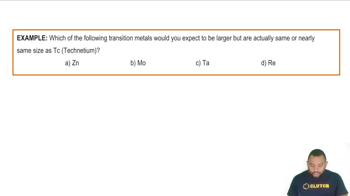
Atomic Radius and Density of Transition Metals Example

Interatomic Distance

Interatomic distance refers to the distance between the centers of two adjacent atoms in a solid. This measurement is crucial for determining atomic and metallic radii, as it provides insight into how closely atoms are packed in a material. In the case of tungsten, the interatomic distance is given as 274 pm, which is essential for calculating the metallic radius.
추천 영상:
가이드 코스
03:29
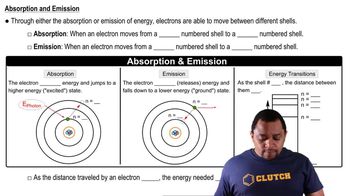
Electronic Transitions

Periodic Trends

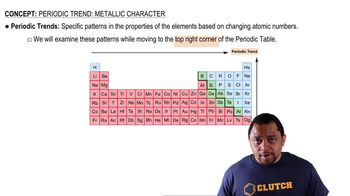
Periodic trends are patterns observed in the properties of elements across the periodic table, including atomic size, ionization energy, and electronegativity. Understanding these trends helps predict how elements behave in different environments. For tungsten, being a transition metal, its properties, including metallic radius, can be compared to those of other metals to understand its unique characteristics.
추천 영상:
가이드 코스
00:38
Periodic Trends
관련 실천
교과서 질문

With the exception of helium, the noble gases condense to form solids when they are cooled sufficiently. At temperatures below 83 K, argon forms a close-packed solid whose structure is shown below. (c) Based on this comparison would you say that the atoms are held together by chemical bonds in solid argon?

601
views
교과서 질문

Tungsten has the highest melting point of any metal in the periodic table: 3422 °C. The distance between W atoms in tungsten metal is 274 pm. (b) If you put tungsten metal under high pressure, predict what would happen to the distance between W atoms.

9137
views
교과서 질문

With the exception of helium, the noble gases condense to form solids when they are cooled sufficiently. At temperatures below 83 K, argon forms a close-packed solid whose structure is shown below. (b) Is this value larger or smaller than the bonding atomic radius estimated for argon in Figure 7.7?

487
views
교과서 질문

Which of the following statements about the bonding atomic radii in Figure 7.7 is incorrect? (i) For a given period, the radii of the representative elements generally decrease from left to right across a period. (ii) The radii of the representative elements for the n = 3 period are all larger than those of the corresponding elements in the n = 2 period. (iii) For most of the representative elements, the change in radius from the n = 2 to the n = 3 period is greater than the change in radius from n = 3 to n = 4. (iv) The radii of the transition elements generally increase moving from left to right within a period. (v) The large radii of the Group 1 elements are due to their relatively small effective nuclear charges.

1124
views
교과서 질문
Which quantity must be determined experimentally in order to determine the bonding atomic radius of an atom? (a) The distance from the nucleus where the probability of finding an electron goes to zero. (b) The distance between the nuclei of two atoms that are bonded together. (c) The effective nuclear charge of an atom.
478
views
교과서 질문

Estimate the As¬I bond length from the data in Figure 7.7 and compare your value to the experimental As ¬I bond length in arsenic triiodide, AsI3, 2.55 Å.

589
views