Ch.1 - Chemical Tools: Experimentation & Measurement
McMurry - Chemistry 8th Edition
McMurry8th EditionChemistryISBN: 9781292336145당신이 사용하는 게 아니라요?교과서 변경
1장, 문제 12

A scientist uses an uncalibrated pH meter and measures the pH of a rainwater sample four times. A different pH meter was calibrated using several solutions with known pH. The true pH of the rain was found by the calibrated pH meter to be 5.12. What can be said about the level of accuracy and precision of the uncalibrated pH meter? (LO 1.14) (a) The uncalibrated pH meter is accurate and precise. (b) The uncalibrated pH meter is neither accurate nor precise. (c) The uncalibrated pH meter is accurate but not precise. (d) The uncalibrated pH meter is precise but not accurate.
검증된 단계별 안내
1
insert step 1> Understand the concepts of accuracy and precision. Accuracy refers to how close a measurement is to the true value, while precision refers to how close repeated measurements are to each other.
insert step 2> Review the measurements taken by the uncalibrated pH meter. If the measurements are close to 5.12, the meter is accurate. If the measurements are close to each other, the meter is precise.
insert step 3> Compare the uncalibrated pH meter's measurements to the true pH value of 5.12. Determine if the measurements are close to this value to assess accuracy.
insert step 4> Examine the consistency of the uncalibrated pH meter's measurements. If the measurements are similar to each other, the meter is precise.
insert step 5> Based on the analysis of accuracy and precision, choose the correct option from the given choices (a, b, c, or d).

비슷한 문제에 대한 검증된 영상 답변:

이 영상 해법은 위 문제에 도움이 된다고 튜터들이 추천한 것입니다.
영상 길이:
2m

주요 개념

질문에 올바르게 답하기 위해 반드시 이해해야 하는 핵심 개념들은 다음과 같습니다.

Accuracy

Accuracy refers to how close a measured value is to the true or accepted value. In this context, the true pH of the rainwater is known to be 5.12, so an accurate measurement would be one that is close to this value. If the uncalibrated pH meter consistently gives readings that differ significantly from 5.12, it would be considered inaccurate.
추천 영상:
가이드 코스
05:50
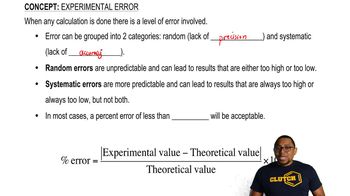
Experimental Error

Precision

Precision indicates the consistency or repeatability of measurements, regardless of their accuracy. If the uncalibrated pH meter provides similar readings across multiple measurements, it is considered precise. However, if those readings are widely spread out or vary significantly, the meter lacks precision, even if some readings might coincidentally be close to the true value.
추천 영상:
가이드 코스
01:49
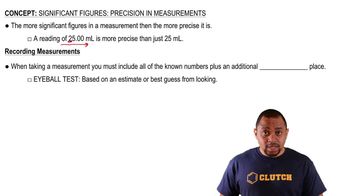
Significant Figures Precision

Calibration

Calibration is the process of adjusting an instrument to ensure its measurements are accurate. A calibrated pH meter uses known pH solutions to set its scale, allowing it to provide reliable readings. In contrast, an uncalibrated pH meter may yield results that are systematically off from the true value, affecting both its accuracy and precision.
추천 영상:
가이드 코스
03:53
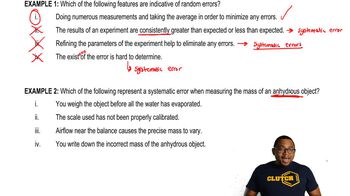
Systematic Error
관련 실천
교과서 질문
A person runs at a pace of 6.52 mi/hr. How long does it take the person to run a 15.0 km race? (1 mi = 1.61 km) (LO 1.17) (a) 85.7 min (b) 222 min (c) 50.0 min (d) 93.4 min
535
views
교과서 질문
Perform the calculation, and report the answer to the correct number of significant figures. (LO 1.16) (a) 1.5 * 10^-4 (b) 1.55 * 10^-4 (c) 1.547 * 10^-4 (d) 1.5473 * 10^-4
337
views
교과서 질문
Report the reading on the buret to the correct number of significant figures. (LO 1.15) (a) 1 mL (b) 1.4 mL (c) 1.40 mL (d) 1.400 mL
742
views
교과서 질문
The cylinder contains two liquids that do not mix with one another: water (density = 1.0 g/mL) and vegetable oil (density = 0.93 g/mL). Four different pieces of plastic are added to the cylinder. Which type of plastic is at the position indicated by the square object in the figure? (LO 1.10) (a) Polyvinyl chloride (density = 1.26 g/mL) (b) Polypropylene (density = 0.90 g/mL) (c) High-density polyethylene (density = 0.96 g/mL) (d) Polyethylene terephthalate (density = 1.38 g/mL)

518
views
교과서 질문
Aerogels are transparent, low-density materials that are nearly 99.8% empty space and excellent insulators against hot and cold. The density of a silica-based aerogel is 3.0 mg/cm3. What is the density in units of g/m3? (LO 1.17) (a) 3.0 * 10-3 g/m3 (b) 3.0 * 101 g/m3 (c) 3.0 g/m3 (d) 3.0 * 103 g/m3
689
views
교과서 질문

An electron with a mass of 9.1 * 10-28 g is traveling at 1.8 * 107 m/s in an electron microscope. Calculate the kinetic energy of electron in units of joules, and report your answer in scientific notation. (LO 1.11) (a) 1.5 * 10-16 J (b) 1.6 * 10-20 J (c) 2.9 * 10-13 J (d) 2.9 * 10-10 J

641
views