Aerogels are transparent, low-density materials that are nearly 99.8% empty space and excellent insulators against hot and cold. The density of a silica-based aerogel is 3.0 mg/cm3. What is the density in units of g/m3? (LO 1.17)
(a) 3.0 * 10-3 g/m3
(b) 3.0 * 101 g/m3
(c) 3.0 g/m3
(d) 3.0 * 103 g/m3
검증된 단계별 안내
1
Convert the given density from mg/cm^3 to g/cm^3 by dividing by 1000, since 1 g = 1000 mg.
Recognize that 1 cm^3 is equivalent to 1 mL, and 1 m^3 is equivalent to 1,000,000 mL.
Convert the density from g/cm^3 to g/m^3 by multiplying by 1,000,000, since there are 1,000,000 cm^3 in 1 m^3.
Perform the multiplication to find the density in g/m^3.
Compare the calculated density with the given options to determine the correct answer.
비슷한 문제에 대한 검증된 영상 답변:
이 영상 해법은 위 문제에 도움이 된다고 튜터들이 추천한 것입니다.
영상 길이:
1m
영상 재생:
0 댓글
주요 개념
질문에 올바르게 답하기 위해 반드시 이해해야 하는 핵심 개념들은 다음과 같습니다.
Density Conversion
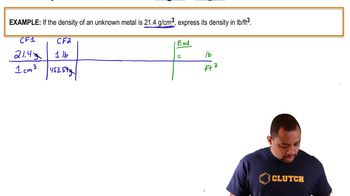
Density is defined as mass per unit volume, typically expressed in units like grams per cubic centimeter (g/cm³) or grams per cubic meter (g/m³). To convert between these units, one must recognize that 1 g/cm³ is equivalent to 1000 g/m³. Therefore, understanding how to convert density from mg/cm³ to g/m³ is essential for solving the problem.
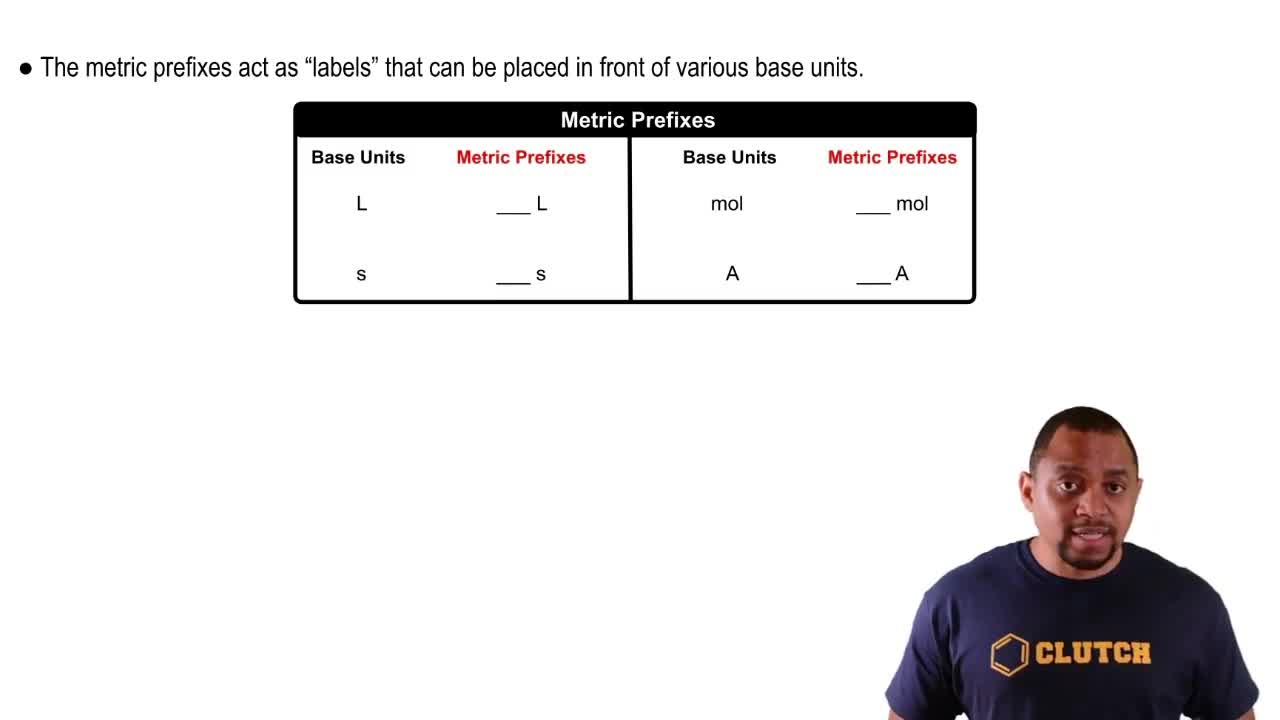
Unit prefixes such as 'milli-' (m) and 'kilo-' (k) are used to denote specific powers of ten. For example, 'milli-' indicates a factor of 10^-3, meaning 1 mg is 0.001 g. Recognizing these prefixes helps in accurately converting measurements and understanding the scale of the values involved in the problem.
Aerogels are unique materials characterized by their low density and high porosity, making them excellent insulators. Their structure, which consists mostly of air, contributes to their thermal insulating properties. Understanding the physical properties of aerogels can provide context for their applications and the significance of their density in practical scenarios.


 검증된 단계별 안내
 05:30
05:30