Perform the calculation, and report the answer to the correct number of significant figures. (LO 1.16)
(a) 1.5 * 10^-4
(b) 1.55 * 10^-4
(c) 1.547 * 10^-4
(d) 1.5473 * 10^-4
검증된 단계별 안내
1
1. The problem is asking you to perform calculations and report the answer to the correct number of significant figures. Significant figures are the digits in a number that carry meaningful information about its precision. In this case, you are simply multiplying a number by a power of 10, which does not change the number of significant figures.
2. For (a) 1.5 * 10^-4, the number 1.5 has two significant figures. Therefore, your answer should also have two significant figures.
3. For (b) 1.55 * 10^-4, the number 1.55 has three significant figures. Therefore, your answer should also have three significant figures.
4. For (c) 1.547 * 10^-4, the number 1.547 has four significant figures. Therefore, your answer should also have four significant figures.
5. For (d) 1.5473 * 10^-4, the number 1.5473 has five significant figures. Therefore, your answer should also have five significant figures.
비슷한 문제에 대한 검증된 영상 답변:
이 영상 해법은 위 문제에 도움이 된다고 튜터들이 추천한 것입니다.
영상 길이:
6m
영상 재생:
0 댓글
주요 개념
질문에 올바르게 답하기 위해 반드시 이해해야 하는 핵심 개념들은 다음과 같습니다.
Significant Figures
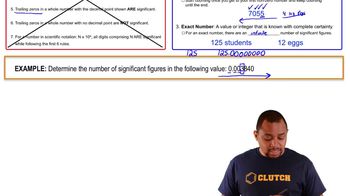
Significant figures are the digits in a number that contribute to its precision. This includes all non-zero digits, any zeros between significant digits, and trailing zeros in the decimal portion. Understanding significant figures is crucial for accurately reporting measurements and calculations in chemistry, as it reflects the precision of the data.
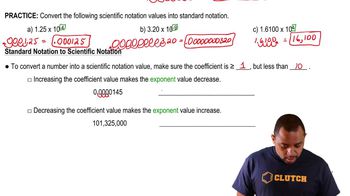
Scientific notation is a way of expressing numbers that are too large or too small to be conveniently written in decimal form. It is represented as a product of a number between 1 and 10 and a power of ten. This notation simplifies calculations and helps maintain significant figures, especially when dealing with very small or very large quantities.
When multiplying numbers in scientific notation, you multiply the coefficients and add the exponents of the powers of ten. The result must then be expressed in proper scientific notation, ensuring that the coefficient remains between 1 and 10. This process is essential for maintaining accuracy and clarity in calculations involving very small or large values.


 검증된 단계별 안내
 01:09
01:09