A person runs at a pace of 6.52 mi/hr. How long does it take the person to run a 15.0 km race? (1 mi = 1.61 km) (LO 1.17)
(a) 85.7 min
(b) 222 min
(c) 50.0 min
(d) 93.4 min
검증된 단계별 안내
1
Step 1: Convert the pace from miles per hour to kilometers per hour using the conversion factor 1 mi = 1.61 km. This will allow us to compare the pace to the race distance, which is given in kilometers.
Step 2: Calculate the time it takes to run the race by dividing the total distance of the race by the pace in kilometers per hour. This will give the time in hours.
Step 3: Convert the time from hours to minutes by multiplying by 60, since there are 60 minutes in an hour. This will give the time in minutes, which is the desired unit for the answer.
Step 4: Compare your answer to the options given in the problem to find the correct answer.
비슷한 문제에 대한 검증된 영상 답변:
이 영상 해법은 위 문제에 도움이 된다고 튜터들이 추천한 것입니다.
영상 길이:
1m
영상 재생:
0 댓글
주요 개념
질문에 올바르게 답하기 위해 반드시 이해해야 하는 핵심 개념들은 다음과 같습니다.
Unit Conversion
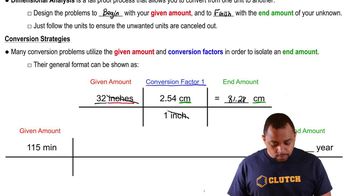
Unit conversion is the process of converting a quantity expressed in one unit to another unit. In this question, it is essential to convert the running speed from miles per hour to kilometers per hour, as the race distance is given in kilometers. Understanding how to apply conversion factors, such as 1 mile = 1.61 kilometers, is crucial for accurate calculations.
The relationship between speed, distance, and time is defined by the formula: speed = distance/time. This means that to find the time taken to cover a certain distance at a given speed, one can rearrange the formula to time = distance/speed. This concept is fundamental in solving the problem, as it allows us to determine how long it takes to run the specified distance.
Dimensional analysis is a mathematical technique used to convert units and ensure that equations are dimensionally consistent. In this problem, it helps verify that the units of speed and distance are compatible when calculating time. By carefully tracking units throughout the calculations, one can avoid errors and confirm that the final answer is expressed in the correct unit of time.


 검증된 단계별 안내
 01:56
01:56