Ch.11 - Liquids & Phase Changes
McMurry - Chemistry 8th Edition
McMurry8th EditionChemistryISBN: 9781292336145당신이 사용하는 게 아니라요?교과서 변경
11장, 문제 53

Ether at room temperature is placed in a flask connected by a rubber tube to a vacuum pump. The pump is turned on, and the ether begins boiling. Explain why this occurs.

검증된 단계별 안내
1
Step 1: Understand that boiling occurs when the vapor pressure of a liquid equals the external pressure acting on it.
Step 2: Recognize that at room temperature, the vapor pressure of ether is lower than atmospheric pressure, so it does not boil under normal conditions.
Step 3: Note that when the vacuum pump is turned on, it reduces the external pressure inside the flask.
Step 4: Realize that as the external pressure decreases, it eventually becomes equal to the vapor pressure of ether at room temperature.
Step 5: Conclude that when the vapor pressure equals the reduced external pressure, the ether begins to boil.

주요 개념

질문에 올바르게 답하기 위해 반드시 이해해야 하는 핵심 개념들은 다음과 같습니다.

Boiling Point and Vapor Pressure

The boiling point of a liquid is the temperature at which its vapor pressure equals the external pressure. Ether has a relatively low boiling point, and as the pressure decreases, its vapor pressure can exceed the external pressure at room temperature, leading to boiling.
추천 영상:
가이드 코스
03:05
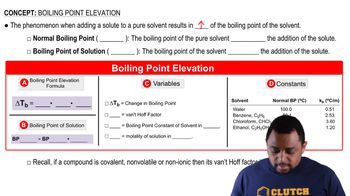
Boiling Point Elevation

Effect of Pressure on Phase Changes

The phase of a substance can change based on the pressure applied. Lowering the pressure using a vacuum pump reduces the external pressure on the ether, allowing it to transition from liquid to gas at a lower temperature than its normal boiling point.
추천 영상:
가이드 코스
01:46
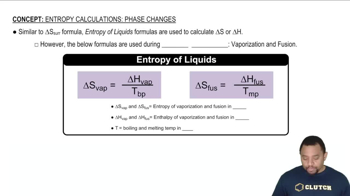
Entropy in Phase Changes

Vacuum Pump Functionality

A vacuum pump removes air and other gases from a sealed environment, creating a low-pressure system. This reduction in pressure facilitates the boiling of liquids like ether at room temperature, as the liquid molecules can escape into the gas phase more easily.
추천 영상:
가이드 코스
03:37
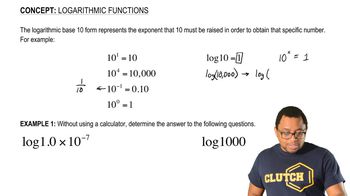
Logarithmic Functions
관련 실천
교과서 질문
Water at room temperature is placed in a flask connected by rubber tubing to a vacuum pump, and the pump is turned on. After several minutes, the volume of the water has decreased, and what remains has turned to ice. Explain
367
views
교과서 질문
Benzene has a melting point of 5.53 °C and a boiling point of 80.09 °C at atmospheric pressure. Its density is0.8787 g>cm3 when liquid and 0.899 g>cm3 when solid; it has Tc = 289.01 °C, Pc = 48.34 atm, Tt = 5.52 °C, and Pt = 0.0473 atm. Starting from a point at 200 K and 66.5 atm, trace the following path on a phase diagram. (1) First, increase T to 585 K while keeping P constant. (2) Next, decrease P to 38.5 atm while keeping T constant. (3) Then, decrease T to 278.66 K while keeping P constant. (4) Finally, decrease P to 0.0025 atm while keeping T constant. What is your starting phase, and what is your final phase?
2486
views
교과서 질문
How much energy in kilojoules is released when 25.0 g of ethanol vapor at 93.0 °C is cooled to -11.0 °C? Ethanol has mp = -114.1 °C, bp = 78.3 °C, ΔHvap = 38.56 kJ>mol, and ΔHfusio#n = 4.93 kJ>mol. The molar heat#capacity is 112.3 J>1K mol2 for the liquid and 65.6 J>1K vapor.
1332
views
1
comments
교과서 질문
Intermolecular forces are important in creating ordered arrangements in liquid crystals. What types of intermolecu- lar forces exist in a sample of the following compound?

410
views
교과서 질문
When ethyl alcohol, CH3CH2OH, dissolves in water, how many hydrogen bonds are formed between one ethyl alcohol molecule and surrounding water molecules? Sketch the hydro- gen bonding interactions. (Hint: Add lone pairs of electrons to the structure before drawing hydrogen bonds.)
1148
views