Ch.11 - Liquids & Phase Changes
McMurry - Chemistry 8th Edition
McMurry8th EditionChemistryISBN: 9781292336145당신이 사용하는 게 아니라요?교과서 변경
11장, 문제 89

Of the substances Xe, CH3Cl, and HF, which has: (a) The smallest dipole–dipole forces?

검증된 단계별 안내
1
Identify the type of bonding and molecular polarity for each substance: Xe is a noble gas with no permanent dipole moment; CH3Cl (methyl chloride) is a polar molecule due to the difference in electronegativity between C-Cl and C-H bonds; HF (hydrogen fluoride) is also a polar molecule with a significant difference in electronegativity between H and F.
Understand that dipole-dipole forces occur between polar molecules where the positive end of one molecule is attracted to the negative end of another molecule.
Recognize that nonpolar molecules like Xe do not exhibit dipole-dipole forces because they lack a permanent dipole moment.
Compare the polarity of CH3Cl and HF. HF has a higher polarity due to the greater electronegativity difference between hydrogen and fluorine compared to the differences in CH3Cl.
Conclude that Xe, being nonpolar, has the smallest dipole-dipole forces among the given substances because it actually exhibits no dipole-dipole forces at all.

비슷한 문제에 대한 검증된 영상 답변:

이 영상 해법은 위 문제에 도움이 된다고 튜터들이 추천한 것입니다.
영상 길이:
2m
도움이 되었나요?

주요 개념

질문에 올바르게 답하기 위해 반드시 이해해야 하는 핵심 개념들은 다음과 같습니다.

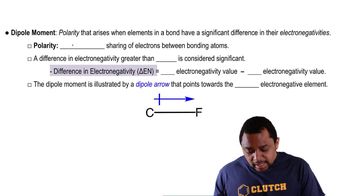
Dipole-Dipole Interactions

Dipole-dipole interactions are attractive forces between the positive end of one polar molecule and the negative end of another. These forces arise due to the uneven distribution of electron density in polar molecules, leading to partial positive and negative charges. The strength of these interactions depends on the polarity of the molecules involved; more polar molecules exhibit stronger dipole-dipole forces.
추천 영상:

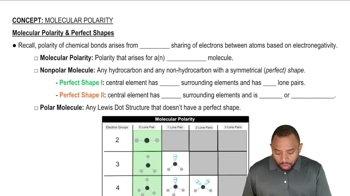
Polarity of Molecules

Polarity refers to the distribution of electrical charge over the atoms in a molecule. A molecule is polar if it has a significant difference in electronegativity between its atoms, resulting in a dipole moment. In the context of the question, understanding the polarity of Xe, CH3Cl, and HF is crucial, as it directly influences the strength of their dipole-dipole interactions.
추천 영상:
가이드 코스
02:38
Molecular Polarity

Molecular Structure and Geometry

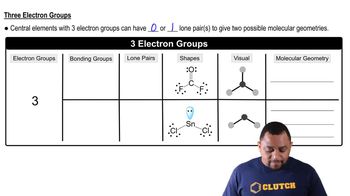
The molecular structure and geometry of a compound determine its polarity and, consequently, its intermolecular forces. For example, the shape of a molecule can affect how charge is distributed across it. In this question, analyzing the molecular geometry of Xe, CH3Cl, and HF helps predict which substance will have the weakest dipole-dipole forces based on their respective polarities and molecular arrangements.
추천 영상:
가이드 코스
01:43
Molecular Geometry with Three Electron Groups