Ch.11 - Liquids & Phase Changes
McMurry - Chemistry 8th Edition
McMurry8th EditionChemistryISBN: 9781292336145당신이 사용하는 게 아니라요?교과서 변경
11장, 문제 86

What is the difference between London dispersion forces and dipole–dipole forces?

검증된 단계별 안내
1
Understand that both London dispersion forces and dipole-dipole forces are types of van der Waals forces, which are intermolecular forces that occur between molecules.
Recognize that London dispersion forces are the weakest type of van der Waals forces and occur between all molecules, whether they are polar or nonpolar. These forces arise due to temporary fluctuations in electron density, which create temporary dipoles.
Identify that dipole-dipole forces occur between molecules that have permanent dipole moments. These forces are stronger than London dispersion forces and result from the electrostatic attraction between the positive end of one polar molecule and the negative end of another.
Compare the strength and occurrence: London dispersion forces are generally weaker and present in all molecular interactions, while dipole-dipole forces are stronger but only present in polar molecules.
Apply this knowledge to predict the physical properties of substances. Substances with stronger intermolecular forces (like dipole-dipole interactions) generally have higher boiling and melting points compared to those with primarily London dispersion forces.

비슷한 문제에 대한 검증된 영상 답변:

이 영상 해법은 위 문제에 도움이 된다고 튜터들이 추천한 것입니다.
영상 길이:
2m
도움이 되었나요?

주요 개념

질문에 올바르게 답하기 위해 반드시 이해해야 하는 핵심 개념들은 다음과 같습니다.

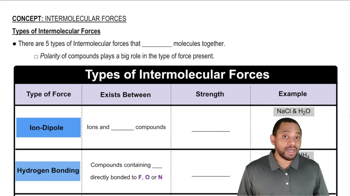
London Dispersion Forces

London dispersion forces are weak intermolecular forces arising from temporary fluctuations in electron density within molecules, leading to the formation of instantaneous dipoles. These forces are present in all molecules, whether polar or nonpolar, and their strength increases with the size and polarizability of the molecules involved. They play a significant role in the physical properties of nonpolar substances.
추천 영상:
가이드 코스
06:44
Types of Intermolecular Forces

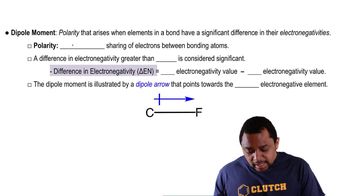
Dipole-Dipole Forces

Dipole-dipole forces are attractive interactions between the positive end of one polar molecule and the negative end of another. These forces occur in molecules that have permanent dipoles due to differences in electronegativity between bonded atoms. Dipole-dipole interactions are generally stronger than London dispersion forces and significantly influence the boiling and melting points of polar substances.
추천 영상:

Intermolecular Forces

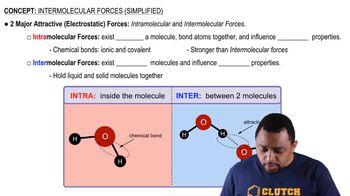
Intermolecular forces are the forces of attraction or repulsion between neighboring particles (atoms, molecules, or ions). They are crucial in determining the physical properties of substances, such as boiling and melting points, solubility, and viscosity. Understanding the different types of intermolecular forces, including London dispersion and dipole-dipole forces, is essential for predicting how substances will behave in various conditions.
추천 영상:
가이드 코스
01:59
Intermolecular vs Intramolecular Forces