Ch.11 - Liquids & Phase Changes
McMurry - Chemistry 8th Edition
McMurry8th EditionChemistryISBN: 9781292336145당신이 사용하는 게 아니라요?교과서 변경
11장, 문제 87

Which substance in each of the following pairs would you expect to have larger dispersion forces? (b) HCl or HI

검증된 단계별 안내
1
Identify the molecular masses of HCl and HI. Dispersion forces increase with increasing molecular mass because larger molecules have more electrons, which can lead to stronger temporary dipoles.
Compare the molecular masses: HCl (Hydrogen Chloride) has a lower molecular mass compared to HI (Hydrogen Iodide).
Consider the polarizability of the molecules. Polarizability refers to how easily the electron cloud around a molecule can be distorted to create temporary dipoles. Larger atoms are generally more polarizable.
Note that iodine in HI is larger and more polarizable than chlorine in HCl. This increased polarizability leads to stronger dispersion forces.
Conclude that HI, having a larger, more polarizable atom and a higher molecular mass, will exhibit larger dispersion forces compared to HCl.

비슷한 문제에 대한 검증된 영상 답변:

이 영상 해법은 위 문제에 도움이 된다고 튜터들이 추천한 것입니다.
영상 길이:
2m

주요 개념

질문에 올바르게 답하기 위해 반드시 이해해야 하는 핵심 개념들은 다음과 같습니다.

Dispersion Forces

Dispersion forces, also known as London dispersion forces, are weak intermolecular forces that arise from temporary fluctuations in electron density within molecules. These fluctuations create instantaneous dipoles, which induce dipoles in neighboring molecules, leading to an attractive force. Dispersion forces are present in all molecules, but they are particularly significant in larger, more polarizable molecules.
추천 영상:
가이드 코스
06:44
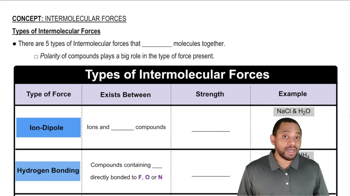
Types of Intermolecular Forces

Molecular Size and Polarizability

Polarizability refers to the ability of an electron cloud around a molecule to be distorted by an external electric field or nearby charges. Larger molecules with more electrons have greater polarizability, resulting in stronger dispersion forces. In comparing substances, the one with the larger atomic or molecular size typically exhibits stronger dispersion forces due to its increased polarizability.
추천 영상:
가이드 코스
02:38
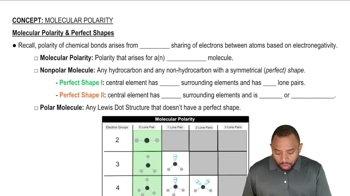
Molecular Polarity

Comparative Analysis of HCl and HI

When comparing HCl (hydrochloric acid) and HI (hydroiodic acid), it is essential to consider their molecular weights and sizes. HI is larger and has more electrons than HCl, leading to greater polarizability and, consequently, stronger dispersion forces. Therefore, in this pair, HI would be expected to have larger dispersion forces due to its size and electron cloud characteristics.
추천 영상:
가이드 코스
06:11
Dimensional Analysis