Ch.2 - Atoms, Molecules & Ions
McMurry - Chemistry 8th Edition
McMurry8th EditionChemistryISBN: 9781292336145당신이 사용하는 게 아니라요?교과서 변경
2장, 문제 85

In addition to carbon monoxide (CO) and carbon dioxide (CO2), there is a third compound of carbon and oxygen called carbon suboxide. If a 2.500 g sample of carbon suboxide contains 1.32 g of C and 1.18 g of O, show that the law of multiple proportions is followed. What is a possible formula for carbon suboxide?

검증된 단계별 안내
1
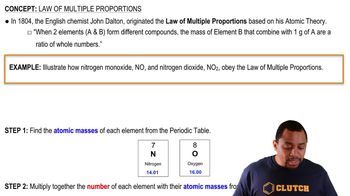
Step 1: Understand the law of multiple proportions, which states that if two elements form more than one compound, the masses of one element that combine with a fixed mass of the other are in the ratio of small whole numbers.
Step 2: Calculate the mass ratio of carbon to oxygen in carbon suboxide by dividing the mass of carbon (1.32 g) by the mass of oxygen (1.18 g).
Step 3: Compare the mass ratio of carbon to oxygen in carbon suboxide with the known mass ratios in carbon monoxide (CO) and carbon dioxide (CO2). For CO, the ratio is 12:16, and for CO2, it is 12:32.
Step 4: Determine if the mass ratio from carbon suboxide can be expressed as a small whole number ratio when compared to the ratios in CO and CO2, thus confirming the law of multiple proportions.
Step 5: Propose a possible formula for carbon suboxide by using the calculated mass ratio and ensuring it aligns with the small whole number ratio requirement.

주요 개념

질문에 올바르게 답하기 위해 반드시 이해해야 하는 핵심 개념들은 다음과 같습니다.

Law of Multiple Proportions

The Law of Multiple Proportions states that when two elements form more than one compound, the ratios of the masses of one element that combine with a fixed mass of the other element can be expressed as small whole numbers. This principle helps to demonstrate that compounds can have different compositions while still being made of the same elements.
추천 영상:
가이드 코스
03:32
Law of Multiple Proportions

Mass Composition of Compounds

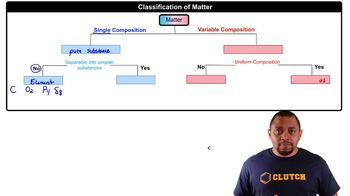
Understanding the mass composition of compounds involves calculating the mass percentages of each element within a compound. In this case, knowing the masses of carbon and oxygen in carbon suboxide allows for the determination of their ratios, which is essential for applying the Law of Multiple Proportions.
추천 영상:
가이드 코스
04:19
Matter Composition

Empirical and Molecular Formulas

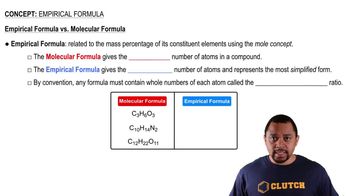
An empirical formula represents the simplest whole-number ratio of elements in a compound, while a molecular formula shows the actual number of atoms of each element in a molecule. By analyzing the mass data of carbon and oxygen in carbon suboxide, one can derive a possible empirical formula, which can then be used to suggest a molecular formula.
추천 영상:
가이드 코스
02:26
Empirical vs Molecular Formula