
Ch.14 - Chemical Kinetics
Tro - Chemistry: A Molecular Approach 4th Edition
Tro4th EditionChemistry: A Molecular ApproachISBN: 9780134112831당신이 사용하는 게 아니라요?교과서 변경
14장, 문제 64

The rate constant (k) for a reaction was measured as a function of temperature. A plot of ln k versus 1/T (in K) is linear and has a slope of -1.01 * 10^4 K. Calculate the activation energy for the reaction.

검증된 단계별 안내
1
Identify the relationship between the slope of the plot and the activation energy using the Arrhenius equation: \( \ln k = \ln A - \frac{E_a}{R} \cdot \frac{1}{T} \).
Recognize that the slope of the plot \( \ln k \) versus \( \frac{1}{T} \) is equal to \( -\frac{E_a}{R} \), where \( E_a \) is the activation energy and \( R \) is the universal gas constant.
Use the given slope \(-1.01 \times 10^4 \text{ K}\) to set up the equation: \(-\frac{E_a}{R} = -1.01 \times 10^4 \text{ K}\).
Solve for the activation energy \( E_a \) by rearranging the equation: \( E_a = 1.01 \times 10^4 \text{ K} \times R \).
Substitute the value of the universal gas constant \( R = 8.314 \text{ J/mol K} \) into the equation to find \( E_a \).

주요 개념

질문에 올바르게 답하기 위해 반드시 이해해야 하는 핵심 개념들은 다음과 같습니다.

Arrhenius Equation

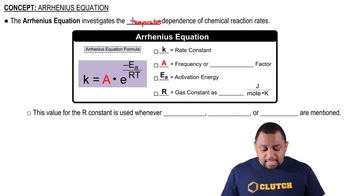
The Arrhenius equation describes how the rate constant (k) of a chemical reaction depends on temperature (T) and activation energy (Ea). It is expressed as k = A * e^(-Ea/RT), where A is the pre-exponential factor, R is the universal gas constant, and T is the temperature in Kelvin. This relationship indicates that as temperature increases, the rate constant typically increases, reflecting a higher likelihood of overcoming the activation energy barrier.
추천 영상:
가이드 코스
01:20
Arrhenius Equation

Activation Energy (Ea)

Activation energy is the minimum energy required for a chemical reaction to occur. It represents the energy barrier that reactants must overcome to transform into products. A higher activation energy means that fewer molecules have sufficient energy to react at a given temperature, resulting in a slower reaction rate. The activation energy can be determined from the slope of a plot of ln k versus 1/T using the equation Ea = -slope * R.
추천 영상:
가이드 코스
02:02
Activity Series Chart

Linear Relationship in ln k vs. 1/T

The linear relationship between ln k and 1/T indicates that the reaction follows the Arrhenius behavior, allowing for the determination of activation energy. The slope of this line is equal to -Ea/R, where R is the gas constant. This linearity suggests that the rate constant changes exponentially with temperature, providing a straightforward method to calculate Ea from experimental data by rearranging the equation to solve for activation energy.
추천 영상:
가이드 코스
02:43
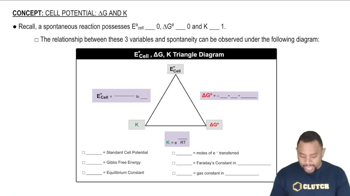
Relationship between ∆E°, ∆G°, and K