뒤로
뒤로
문제 81
Hydrogenation reactions are used to add hydrogen across double bonds in hydrocarbons and other organic compounds. Use average bond energies to calculate ΔHrxn for the hydrogenation reaction. H2C=CH2(g) + H2(g) → H3C–CH3(g)
문제 82
Ethanol is a possible fuel. Use average bond energies to calculate ΔHrxn for the combustion of ethanol. CH3CH2OH(g) + 3 O2(g) → 2 CO2(g) + 3 H2O(g)
- Hydrogen, a potential future fuel, can be produced from carbon (from coal) and steam by this reaction: C(s) + 2 H2O(g) -> H2(g) + CO2(g). Use average bond energies to calculate ΔHrxn for the reaction.
문제 83
문제 84
In the Chemistry and the Environment box on free radicals in this chapter, we discussed the importance of the hydroxyl radical in reacting with and eliminating many atmospheric pollutants. However, the hydroxyl radical does not clean up everything. For example, chlorofluorocarbons—which destroy stratospheric ozone—are not attacked by the hydroxyl radical. Consider the hypothetical reaction by which the hydroxyl radical might react with a chlorofluorocarbon: OH(g) + CF2Cl2(g) → HOF(g) + CFCl2(g) Use bond energies to explain why this reaction is improbable. (The C–F bond energy is 552 kJ/mol.)
- Write an appropriate Lewis structure for each compound. Make certain to distinguish between ionic and molecular compounds. a. BI3 c. HCFO b. K2S d. PBr3
문제 85
문제 86b
Write an appropriate Lewis structure for each compound. Make certain to distinguish between ionic and molecular compounds. b. ClF5
문제 87a
Each compound contains both ionic and covalent bonds. Write ionic Lewis structures for each, including the covalent structure for the ion in brackets. Write resonance structures if necessary. a. BaCO3
문제 87b,c,d
Each compound contains both ionic and covalent bonds. Write ionic Lewis structures for each, including the covalent structure for the ion in brackets. Write resonance structures if necessary. b. Ca(OH)2 c. KNO3 d. LiIO
- Does each compound contain both ionic and covalent bonds? Write ionic Lewis structures for each of them, including the covalent structure for the ion in brackets. Write resonance structures if necessary for the following: b. NH4Cl, d. Sr(CN)2, a. RbIO2, c. KOH.
문제 88
문제 89
Carbon ring structures are common in organic chemistry. Draw a Lewis structure for each carbon ring structure, including any necessary resonance structures. a. C4H8 b. C4H4 c. C6H12 d. C6H6
문제 90
Amino acids are the building blocks of proteins. The simplest amino acid is glycine (H2NCH2COOH). Draw a Lewis structure for glycine. (Hint: The central atoms in the skeletal structure are nitrogen and the two carbon atoms. Each oxygen atom is bonded directly to the right-most carbon atom.)
문제 91
Formic acid is responsible for the sting of ant bites. By mass, formic acid is 26.10% C, 4.38% H, and 69.52% O. The molar mass of formic acid is 46.02 g/mol. Determine the molecular formula of formic acid and draw its Lewis structure.
문제 92
Diazomethane is a highly poisonous, explosive compound because it readily evolves N2. Diazomethane has the following composition by mass: 28.57% C; 4.80% H; and 66.64% N. The molar mass of diazomethane is 42.04 g/mol. Find the molecular formula of diazomethane, draw its Lewis structure, and assign formal charges to each atom. Why is diazomethane not very stable? Explain.
문제 93
The reaction of Fe2O3(s) with Al(s) to form Al2O3(s) and Fe(s) is called the thermite reaction and is highly exothermic. What role does lattice energy play in the exothermicity of the reaction?
문제 94
NaCl has a lattice energy of -787 kJ/mol. Consider a hypothetical salt XY. X3+ has the same radius of Na+ and Y3- has the same radius as Cl-. Estimate the lattice energy of XY.
- Draw the Lewis structure for nitric acid, ensuring the hydrogen atom is attached to one of the oxygen atoms. Include all three resonance structures by alternating the double bond among the three oxygen atoms. Use formal charge to determine which of the resonance structures is most important to the structure of nitric acid.
문제 95
- Phosgene (Cl2CO) is a poisonous gas used as a chemical weapon during World War I. It is a potential agent for chemical terrorism today. Draw the Lewis structure of phosgene, including all three resonance forms by alternating the double bond among the three terminal atoms. Which resonance structure is the best?
문제 96
문제 97
The cyanate ion (OCN-) and the fulminate ion (CNO-) share the same three atoms but have vastly different properties. The cyanate ion is stable, while the fulminate ion is unstable and forms explosive compounds. The resonance structures of the cyanate ion are explored in Example 9.8. Draw Lewis structures for the fulminate ion—including possible resonance forms— and use formal charge to explain why the fulminate ion is less stable (and therefore more reactive) than the cyanate ion.
문제 98a,d
Draw the Lewis structure for each organic compound from its condensed structural formula. a. C3H8 d. CH3COOH
문제 98b
Draw the Lewis structure for each organic compound from its condensed structural formula. b. CH3OCH3
문제 98c
Draw the Lewis structure for each organic compound from its condensed structural formula. c. CH3COCH3
문제 98e
Draw the Lewis structure for each organic compound from its condensed structural formula. e. CH3CHO
문제 99
Draw the Lewis structure for each organic compound from its condensed structural formula. a. C2H4 b. CH3NH2 c. HCHO d. CH3CH2OH e. HCOOH
문제 100
Use Lewis structures to explain why Br3- and I3- are stable, while F3- is not.
- Draw the Lewis structure for HCSNH2. The carbon and nitrogen atoms are bonded together, and the sulfur atom is bonded to the carbon atom. Label each bond in the molecule as polar or nonpolar.
문제 101
문제 102
Draw the Lewis structure for urea, H2NCONH2, one of the compounds responsible for the smell of urine. (The central carbon atom is bonded to both nitrogen atoms and to the oxygen atom.) Does urea contain polar bonds? Which bond in urea is most polar?
- Draw Lewis structures for each free radical implicated in this theory of aging: a. O2- b. O-
문제 103
문제 103c
Some theories of aging suggest that free radicals cause certain diseases and perhaps aging in general. As you know from the Lewis model, such molecules are not chemically stable and will quickly react with other molecules. According to certain theories, free radicals may attack molecules within the cell, such as DNA, changing them and causing cancer or other diseases. Free radicals may also attack molecules on the surfaces of cells, making them appear foreign to the body's immune system. The immune system then attacks the cells and destroys them, weakening the body. Draw Lewis structures for each free radical implicated in this theory of aging. c. OH
문제 103d
Some theories of aging suggest that free radicals cause certain diseases and perhaps aging in general. As you know from the Lewis model, such molecules are not chemically stable and will quickly react with other molecules. According to certain theories, free radicals may attack molecules within the cell, such as DNA, changing them and causing cancer or other diseases. Free radicals may also attack molecules on the surfaces of cells, making them appear foreign to the body's immune system. The immune system then attacks the cells and destroys them, weakening the body. Draw Lewis structures for each free radical implicated in this theory of aging. d. CH3OO (unpaired electron on terminal oxygen)
문제 104
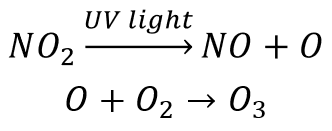
Free radicals are important in many environmentally significant reactions (see the Chemistry in the Environment box on free radicals in this chapter). For example, photochemical smog— smog that results from the action of sunlight on air pollutants— forms in part by these two steps:
The product of this reaction, ozone, is a pollutant in the lower atmosphere. (Upper atmospheric ozone is a natural part of the atmosphere that protects life on Earth from ultraviolet light.) Ozone is an eye and lung irritant and also accelerates the weathering of rubber products. Rewrite the given reactions using the Lewis structure of each reactant and product. Identify the free radicals.