Ch. 10 - DNA Structure and Analysis
Klug - Concepts of Genetics 12th Edition
Klug12th EditionConcepts of GeneticsISBN: 9780135564776당신이 사용하는 게 아니라요?교과서 변경
10장, 문제 10

Draw the chemical structure of the three components of a nucleotide, and then link the three together. What atoms are removed from the structures when the linkages are formed?

검증된 단계별 안내
1
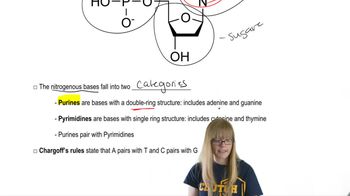
Identify the three components of a nucleotide: a nitrogenous base, a five-carbon sugar (deoxyribose in DNA or ribose in RNA), and a phosphate group.
Draw the chemical structure of the nitrogenous base, which can be a purine (adenine or guanine) or a pyrimidine (cytosine, thymine, or uracil). These bases contain nitrogen and carbon atoms arranged in one or two rings.
Draw the five-carbon sugar structure, showing the carbon atoms numbered 1' through 5'. The sugar has hydroxyl (-OH) groups attached, with the 1' carbon linked to the nitrogenous base and the 5' carbon linked to the phosphate group.
Draw the phosphate group as a phosphorus atom bonded to four oxygen atoms, one of which forms a bond with the 5' carbon of the sugar.
Explain the formation of the nucleotide by linking the nitrogenous base to the sugar via a glycosidic bond (between the 1' carbon of the sugar and a nitrogen atom of the base), and linking the phosphate group to the sugar via a phosphoester bond (between the phosphate and the 5' carbon of the sugar). During these linkages, a water molecule (H₂O) is removed in each condensation reaction: one when the base attaches to the sugar and one when the phosphate attaches to the sugar.

비슷한 문제에 대한 검증된 영상 답변:

이 영상 해법은 위 문제에 도움이 된다고 튜터들이 추천한 것입니다.
영상 길이:
1m
도움이 되었나요?

주요 개념

질문에 올바르게 답하기 위해 반드시 이해해야 하는 핵심 개념들은 다음과 같습니다.

Components of a Nucleotide

A nucleotide consists of three parts: a nitrogenous base (adenine, thymine, cytosine, guanine, or uracil), a five-carbon sugar (deoxyribose in DNA or ribose in RNA), and one or more phosphate groups. Each component has a distinct chemical structure essential for forming nucleic acids.
추천 영상:

Phosphodiester Bond Formation

Nucleotides link together via phosphodiester bonds, which connect the 3' hydroxyl group of one sugar to the 5' phosphate group of the next. This linkage forms the sugar-phosphate backbone of DNA or RNA, creating a stable chain essential for genetic information storage.
추천 영상:
가이드 코스
04:06
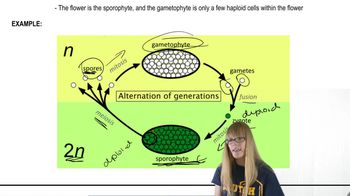
Formation of Plant Gametes

Dehydration Synthesis in Nucleotide Linking

When nucleotides join, a dehydration reaction occurs, removing a water molecule (H2O). Specifically, a hydroxyl group (OH) from the sugar and a hydrogen (H) from the phosphate group are lost, enabling the formation of the phosphodiester bond that links nucleotides.
추천 영상:
가이드 코스
07:56
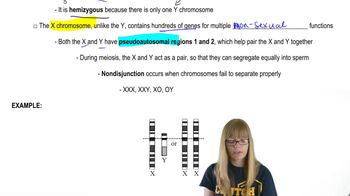
Sex-Linked Genes