What evidence did Watson and Crick have at their disposal in 1953? What was their approach in arriving at the structure of DNA?
Ch. 10 - DNA Structure and Analysis

10장, 문제 13
Draw the chemical structure of a dinucleotide composed of A and G. Opposite this structure, draw the dinucleotide composed of T and C in an antiparallel (or upside-down) fashion. Form the possible hydrogen bonds.
검증된 단계별 안내1
Step 1: Begin by drawing the chemical structure of the first dinucleotide composed of adenine (A) and guanine (G). Each nucleotide consists of three parts: a phosphate group, a deoxyribose sugar, and a nitrogenous base (A or G). Connect the phosphate group of the first nucleotide to the 5' carbon of its sugar, and link the 3' carbon of the sugar to the phosphate group of the next nucleotide, forming a phosphodiester bond between A and G.
Step 2: Next, draw the complementary dinucleotide composed of thymine (T) and cytosine (C) in an antiparallel orientation relative to the first strand. This means the 5' end of the T-C strand aligns opposite the 3' end of the A-G strand, so the sugar-phosphate backbone runs in the opposite direction.
Step 3: Position the nitrogenous bases of the two strands so that adenine (A) pairs opposite thymine (T), and guanine (G) pairs opposite cytosine (C). Remember that A-T pairs form two hydrogen bonds, while G-C pairs form three hydrogen bonds.
Step 4: Illustrate the hydrogen bonds between the complementary bases. For A-T, draw two dashed lines representing the two hydrogen bonds; for G-C, draw three dashed lines representing the three hydrogen bonds. These bonds stabilize the double-stranded structure.
Step 5: Review the entire structure to ensure correct antiparallel orientation, proper phosphodiester linkages, and accurate base pairing with hydrogen bonds. This completes the depiction of the dinucleotide duplex with complementary base pairing.

비슷한 문제에 대한 검증된 영상 답변:
이 영상 해법은 위 문제에 도움이 된다고 튜터들이 추천한 것입니다.
영상 길이:
2m도움이 되었나요?
주요 개념
질문에 올바르게 답하기 위해 반드시 이해해야 하는 핵심 개념들은 다음과 같습니다.
Dinucleotide Structure
A dinucleotide consists of two nucleotides linked by a phosphodiester bond between the 3' hydroxyl of one sugar and the 5' phosphate of the next. Each nucleotide includes a sugar (deoxyribose in DNA), a phosphate group, and a nitrogenous base (A, T, G, or C). Understanding this structure is essential to accurately draw the backbone and base components.
추천 영상:
가이드 코스
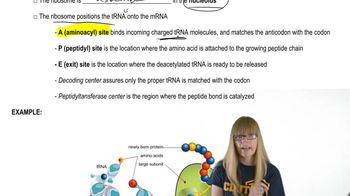
Ribosome Structure
Antiparallel Orientation of DNA Strands
DNA strands run in opposite directions, with one strand oriented 5' to 3' and the complementary strand 3' to 5'. This antiparallel arrangement is crucial when positioning dinucleotides opposite each other, ensuring proper alignment of bases for hydrogen bonding.
추천 영상:
가이드 코스
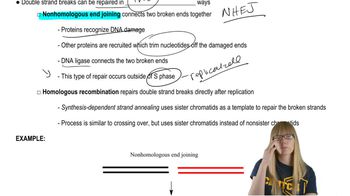
Double Strand Breaks
Base Pairing and Hydrogen Bonding
In DNA, adenine (A) pairs with thymine (T) via two hydrogen bonds, and guanine (G) pairs with cytosine (C) via three hydrogen bonds. These specific interactions stabilize the double helix and must be shown when drawing complementary dinucleotides in antiparallel orientation.
추천 영상:
가이드 코스
Base Distortions
관련 실천
교과서 질문
879
views
교과서 질문
Adenine may also be named 6-amino purine. How would you name the other four nitrogenous bases, using this alternative system? (O is indicated by 'oxy-,' and CH₃ by 'methyl.')
996
views
교과서 질문
What might Watson and Crick have concluded had Chargaff's data from a single source indicated the following?
Why would this conclusion be contradictory to Wilkins's and Franklin's data?
549
views
교과서 질문
How are the carbon and nitrogen atoms of the sugars, purines, and pyrimidines numbered?
794
views
교과서 질문
Draw the chemical structure of the three components of a nucleotide, and then link the three together. What atoms are removed from the structures when the linkages are formed?
857
views
교과서 질문
Describe the various characteristics of the Watson–Crick double-helix model for DNA.
763
views