Ch. 10 - DNA Structure and Analysis
Klug - Concepts of Genetics 12th Edition
Klug12th EditionConcepts of GeneticsISBN: 9780135564776당신이 사용하는 게 아니라요?교과서 변경
10장, 문제 15

What evidence did Watson and Crick have at their disposal in 1953? What was their approach in arriving at the structure of DNA?

검증된 단계별 안내
1
Understand the historical context: Watson and Crick worked in 1953 when the structure of DNA was unknown, but several key pieces of experimental evidence were already available.
Identify the main evidence they used: They had access to X-ray diffraction images of DNA, particularly the famous Photo 51 taken by Rosalind Franklin, which suggested a helical structure.
Consider Chargaff's rules: They knew from Erwin Chargaff's findings that the amount of adenine (A) equals thymine (T), and the amount of guanine (G) equals cytosine (C), indicating base pairing.
Recognize their approach: Watson and Crick used model building, combining the chemical knowledge of nucleotide components and the physical constraints suggested by the X-ray data to propose a double helix structure.
Summarize their reasoning: They integrated experimental data (X-ray diffraction and base composition) with chemical principles to deduce that DNA consists of two antiparallel strands forming a double helix with complementary base pairing.

비슷한 문제에 대한 검증된 영상 답변:

이 영상 해법은 위 문제에 도움이 된다고 튜터들이 추천한 것입니다.
영상 길이:
2m
도움이 되었나요?

주요 개념

질문에 올바르게 답하기 위해 반드시 이해해야 하는 핵심 개념들은 다음과 같습니다.

X-ray Crystallography

X-ray crystallography is a technique used to determine the three-dimensional structure of molecules by analyzing the pattern of X-rays diffracted through crystallized samples. Rosalind Franklin's X-ray diffraction images of DNA, especially Photo 51, provided critical evidence about the helical structure and dimensions of DNA that guided Watson and Crick.
추천 영상:

Base Pairing and Complementarity

Base pairing refers to the specific hydrogen bonding between nucleotide bases: adenine pairs with thymine, and guanine pairs with cytosine. Watson and Crick used Chargaff's rules, which showed equal amounts of A and T and equal amounts of G and C, to propose complementary base pairs that explained DNA's uniform width and replication mechanism.
추천 영상:
가이드 코스
05:05
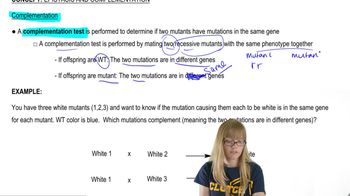
Complementation

Model Building Approach

Watson and Crick used a model-building approach, assembling physical models of DNA components to test structural hypotheses. By integrating experimental data and chemical knowledge, they iteratively refined their model to fit the known constraints, ultimately proposing the double helix structure that explained DNA's properties.
추천 영상:
가이드 코스
14:31
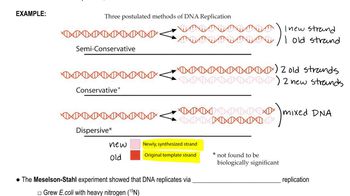
Semiconservative Replication