Ch. 10 - DNA Structure and Analysis
Klug - Concepts of Genetics  12th Edition
Klug12th EditionConcepts of Genetics ISBN: 9780135564776당신이 사용하는 게 아니라요?교과서 변경
10장, 문제 16

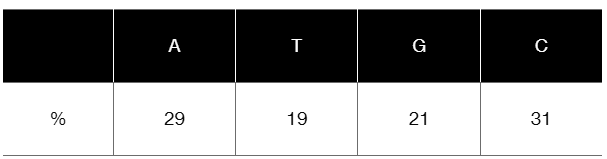
What might Watson and Crick have concluded had Chargaff's data from a single source indicated the following?
Table showing nucleotide percentages: A 29%, T 19%, G 21%, C 31%, highlighting base composition discrepancies.
Why would this conclusion be contradictory to Wilkins's and Franklin's data?

검증된 단계별 안내
1
Step 1: Understand Chargaff's rules, which state that in double-stranded DNA, the amount of adenine (A) equals thymine (T), and the amount of guanine (G) equals cytosine (C). This is because A pairs with T, and G pairs with C in the DNA double helix.
Step 2: Analyze the given nucleotide percentages: A = 29%, T = 19%, G = 21%, and C = 31%. Notice that the percentages of A and T are not equal (29% vs. 19%), nor are G and C equal (21% vs. 31%). This violates Chargaff's rules.
Step 3: Consider what Watson and Crick might conclude from this data. Since the base pairing rules require equal amounts of complementary bases, the unequal percentages would suggest that the DNA is not double-stranded or does not follow the base pairing model they proposed.
Step 4: Compare this conclusion to Wilkins's and Franklin's X-ray diffraction data, which provided evidence for a double helix structure with complementary base pairing. Their data implied equal base pairing, consistent with Chargaff's rules.
Step 5: Recognize the contradiction: if Chargaff's data showed unequal base pairs, it would conflict with the structural evidence from Wilkins and Franklin, challenging the double helix model and the concept of complementary base pairing.

비슷한 문제에 대한 검증된 영상 답변:

이 영상 해법은 위 문제에 도움이 된다고 튜터들이 추천한 것입니다.
영상 길이:
1m
도움이 되었나요?

주요 개념

질문에 올바르게 답하기 위해 반드시 이해해야 하는 핵심 개념들은 다음과 같습니다.

Chargaff's Rules

Chargaff's rules state that in DNA, the amount of adenine (A) equals thymine (T), and guanine (G) equals cytosine (C). This base pairing is fundamental to the double helix structure, ensuring complementary strands. Deviations from these ratios suggest an unusual or non-standard DNA structure.
추천 영상:
가이드 코스
08:44
Genetics Basics

Watson and Crick's DNA Model

Watson and Crick proposed the double helix model where A pairs with T and G pairs with C, explaining Chargaff's equal base ratios. Their model relies on complementary base pairing to maintain consistent width and stability of the DNA molecule.
추천 영상:
가이드 코스
09:32
History and Experiments

X-ray Diffraction Data from Wilkins and Franklin

Wilkins and Franklin's X-ray diffraction images revealed the helical structure of DNA and consistent spacing between strands. Their data supported the double helix model and implied uniform base pairing, which would be contradicted by unequal base percentages as shown in the table.
추천 영상:
가이드 코스
09:32
History and Experiments