Ch. 14 - Translation and Proteins
Klug - Concepts of Genetics 12th Edition
Klug12th EditionConcepts of GeneticsISBN: 9780135564776당신이 사용하는 게 아니라요?교과서 변경
14장, 문제 11

When a codon in an mRNA with the sequence 5'-UAA-3' enters the A site of a ribosome, it is not recognized by a tRNA with a complementary anticodon. Why not? What recognizes it instead?

검증된 단계별 안내
1
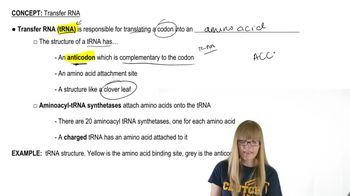
Understand the role of codons and anticodons: Codons are sequences of three nucleotides in mRNA that specify amino acids during translation. Anticodons are complementary sequences on tRNA molecules that pair with codons to deliver the correct amino acid.
Identify the codon in question: The codon 5'-UAA-3' is one of the three stop codons (UAA, UAG, UGA) in the genetic code. Stop codons do not code for any amino acid.
Explain why tRNA does not recognize stop codons: Stop codons are not recognized by tRNA because there are no tRNAs with anticodons complementary to stop codons. This ensures that translation stops at the appropriate point.
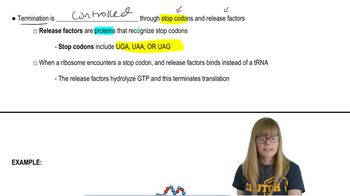
Describe what recognizes stop codons: Instead of tRNA, stop codons are recognized by proteins called release factors. These release factors bind to the stop codon in the A site of the ribosome.
Explain the role of release factors: Release factors trigger the hydrolysis of the bond between the polypeptide chain and the tRNA in the P site, releasing the completed polypeptide and terminating translation.

비슷한 문제에 대한 검증된 영상 답변:

이 영상 해법은 위 문제에 도움이 된다고 튜터들이 추천한 것입니다.
영상 길이:
1m
도움이 되었나요?

주요 개념

질문에 올바르게 답하기 위해 반드시 이해해야 하는 핵심 개념들은 다음과 같습니다.

Codons and Anticodons

Codons are sequences of three nucleotides in mRNA that specify an amino acid or signal termination during protein synthesis. Each codon is matched by a complementary anticodon found on tRNA molecules, which carry specific amino acids. In the case of the UAA codon, it is a stop codon, meaning it does not have a corresponding tRNA with an anticodon, as it signals the termination of translation.
추천 영상:

Stop Codons

Stop codons are specific codons in mRNA that signal the end of protein synthesis. The three stop codons—UAA, UAG, and UGA—do not code for any amino acids and are recognized by release factors instead of tRNA. When a ribosome encounters a stop codon in the A site, it triggers the release of the newly synthesized polypeptide chain from the ribosome.
추천 영상:
가이드 코스
01:55
Translation Termination

Release Factors

Release factors are proteins that recognize stop codons during translation. When a ribosome reaches a stop codon, such as UAA, a release factor binds to the A site, prompting the ribosome to release the completed polypeptide chain. This process is crucial for terminating protein synthesis and ensuring that proteins are properly formed and released.
추천 영상:
가이드 코스
08:52
F Factor and Hfr