Ch. 15 - Gene Mutation, DNA Repair, and Transposition
Klug - Concepts of Genetics 12th Edition
Klug12th EditionConcepts of GeneticsISBN: 9780135564776당신이 사용하는 게 아니라요?교과서 변경
15장, 문제 7

Most mutations in a diploid organism are recessive. Why?

검증된 단계별 안내
1
Understand the concept of diploidy: In diploid organisms, each gene exists in two copies (alleles), one inherited from each parent.
Recall that a recessive mutation typically results in a loss of function or reduced function of the gene product, which means the mutated allele does not produce a functional protein.
Recognize that if one allele is mutated (recessive) and the other allele is normal (wild-type), the normal allele often produces enough functional protein to mask the effect of the mutated allele.
This masking effect means the organism shows the normal phenotype despite carrying the mutation, so the mutation is recessive because its effect is hidden in the presence of a normal allele.
Conclude that most mutations are recessive because loss-of-function mutations usually do not affect the phenotype unless both alleles are mutated, which is less common.

비슷한 문제에 대한 검증된 영상 답변:

이 영상 해법은 위 문제에 도움이 된다고 튜터들이 추천한 것입니다.
영상 길이:
28s
도움이 되었나요?

주요 개념

질문에 올바르게 답하기 위해 반드시 이해해야 하는 핵심 개념들은 다음과 같습니다.

Diploidy and Allelic Pairs

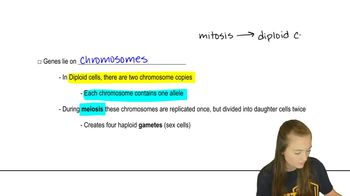
Diploid organisms have two copies of each gene, called alleles. This means that if one allele carries a mutation, the other normal allele can often compensate, masking the effect of the mutation in the organism's phenotype.
추천 영상:
가이드 코스
27:36
Diploid Genetics

Recessive vs. Dominant Mutations

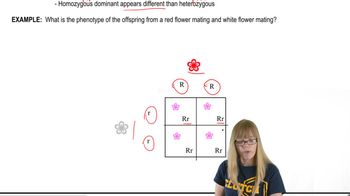
A recessive mutation only affects the phenotype when both alleles are mutated, while a dominant mutation shows its effect even if only one allele is mutated. Most mutations are recessive because the normal allele usually produces enough functional protein to maintain normal function.
추천 영상:
가이드 코스
04:37
Variations on Dominance

Gene Function and Protein Production

Many mutations reduce or eliminate the function of a gene product, but as long as one allele produces sufficient functional protein, the organism remains unaffected. This functional redundancy explains why most mutations are recessive in diploid organisms.
추천 영상: