Ch. 15 - Gene Mutation, DNA Repair, and Transposition
Klug - Concepts of Genetics 12th Edition
Klug12th EditionConcepts of GeneticsISBN: 9780135564776당신이 사용하는 게 아니라요?교과서 변경
15장, 문제 4

Why would a mutation in a somatic cell of a multicellular organism not necessarily result in a detectable phenotype?

검증된 단계별 안내
1
Understand the difference between somatic cells and germ cells: Somatic cells make up the body tissues and organs, while germ cells are involved in reproduction and give rise to gametes.
Recognize that mutations in somatic cells affect only the individual cell and its descendants, not the entire organism or its offspring.
Consider that many somatic cells are part of large tissues where a mutation in a single cell may be diluted or masked by the normal function of surrounding cells.
Acknowledge that some mutations may not affect gene function significantly or may occur in non-coding regions, resulting in no visible change in phenotype.
Realize that the organism's overall phenotype depends on the collective function of many cells, so a mutation in one somatic cell often does not produce a detectable change.

비슷한 문제에 대한 검증된 영상 답변:

이 영상 해법은 위 문제에 도움이 된다고 튜터들이 추천한 것입니다.
영상 길이:
30s
도움이 되었나요?

주요 개념

질문에 올바르게 답하기 위해 반드시 이해해야 하는 핵심 개념들은 다음과 같습니다.

Somatic vs. Germline Cells

Somatic cells make up the body tissues and organs, while germline cells give rise to gametes. Mutations in somatic cells affect only the individual cell lineage and are not inherited by offspring, limiting their impact to the organism itself.
추천 영상:
가이드 코스
03:52
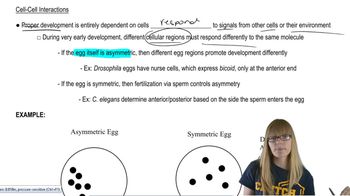
Cell-cell interactions

Phenotypic Expression and Cell Lineage

A mutation in a single somatic cell may not produce a visible phenotype if the mutated cell represents a small portion of the tissue or if the mutation does not affect critical genes. Phenotypic changes often require widespread or functionally significant mutations.
추천 영상:
가이드 코스
02:09
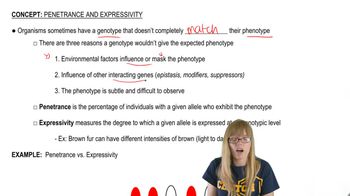
Penetrance and Expressivity

Genetic Redundancy and Cellular Compensation

Organisms often have redundant genes or pathways that can compensate for the effects of a mutation. Additionally, neighboring cells can mitigate the impact of a mutated cell, preventing the mutation from manifesting as a detectable phenotype.
추천 영상:
가이드 코스
08:30
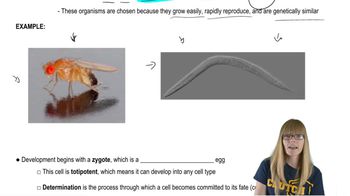
Genetics of Development