Ch. 6 - Genetic Analysis and Mapping in Bacteria and Bacteriophages
Klug - Concepts of Genetics 12th Edition
Klug12th EditionConcepts of GeneticsISBN: 9780135564776당신이 사용하는 게 아니라요?교과서 변경
6장, 문제 16

If a single bacteriophage infects one E. coli cell present on a lawn of bacteria and, upon lysis, yields 200 viable viruses, how many phages will exist in a single plaque if three more lytic cycles occur?
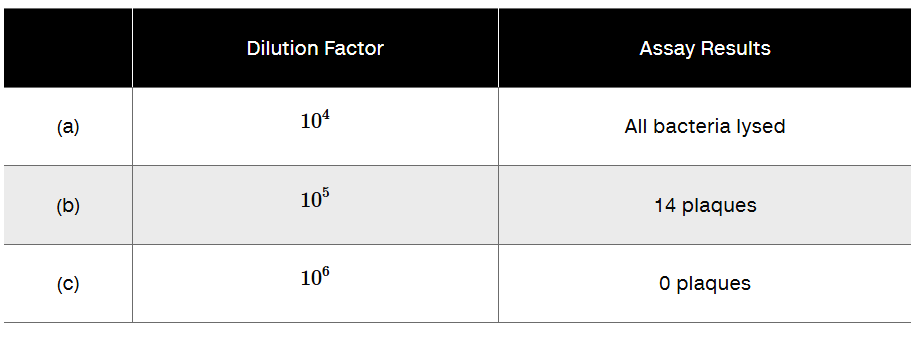
Table showing dilution factors 10^4 to 10^6 with assay results from all bacteria lysed to 14 and 0 plaques.

검증된 단계별 안내
1
Understand the problem: A single bacteriophage infects one E. coli cell and produces 200 viable viruses after one lytic cycle. We need to find how many phages will be present after three additional lytic cycles.
Recall that each lytic cycle multiplies the number of phages by the burst size (number of viruses produced per infected cell). Here, the burst size is 200.
Set up the calculation: After the first infection, there are 200 phages. After one more lytic cycle, the number of phages will be multiplied by 200 again, and this repeats for each additional cycle.
Express the total number of phages after three more lytic cycles as an exponential growth: \$200^{n}\(, where \)n$ is the number of cycles. Since we start with 200 after the first cycle, after three more cycles, the total phages will be \(200 \times 200^{3}\).
Calculate the total number of phages by multiplying the initial burst size by itself for the number of additional cycles, i.e., \$200^{4}$, but do not compute the final number as per instructions.

비슷한 문제에 대한 검증된 영상 답변:

이 영상 해법은 위 문제에 도움이 된다고 튜터들이 추천한 것입니다.
영상 길이:
1m
도움이 되었나요?

주요 개념

질문에 올바르게 답하기 위해 반드시 이해해야 하는 핵심 개념들은 다음과 같습니다.

Lytic Cycle of Bacteriophages

The lytic cycle is a viral replication process where a bacteriophage infects a bacterial cell, replicates its genome, produces new phage particles, and causes the host cell to lyse, releasing progeny viruses. Each cycle results in a burst of new phages, quantified as the burst size.
추천 영상:
가이드 코스
04:29
Bacteriophage Life Cycle

Burst Size

Burst size refers to the number of new phage particles released from a single infected bacterial cell after lysis. It is a critical parameter for calculating phage population growth during successive lytic cycles, as each cycle multiplies the phage count by the burst size.
추천 영상:
가이드 코스
04:29
Bacteriophage Life Cycle

Plaque Formation and Dilution Assays

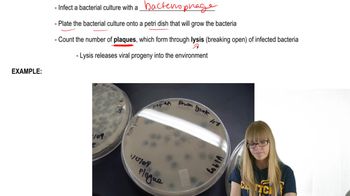
Plaques are clear zones on a bacterial lawn caused by phage-induced lysis of bacteria. Dilution assays help quantify phage concentration by counting plaques at different dilution factors, linking the number of plaques to the number of infectious phage particles in the sample.
추천 영상:
가이드 코스
03:44
Plaques and Experiments