
교과서 질문
Explain the observations that led Zinder and Lederberg to conclude that the prototrophs recovered in their transduction experiments were not the result of F⁺ mediated conjugation.
1014
views

 검증된 단계별 안내
 06:04
06:04
 03:44
03:44 07:58
07:58Explain the observations that led Zinder and Lederberg to conclude that the prototrophs recovered in their transduction experiments were not the result of F⁺ mediated conjugation.
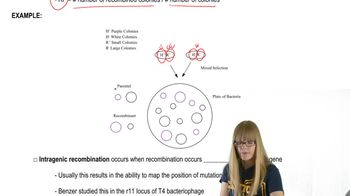
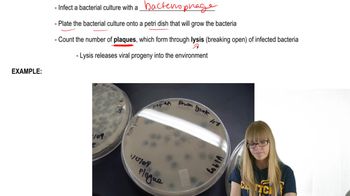
Define plaque, lysogeny, and prophage.
Two theoretical genetic strains of a virus (a⁻b⁻c⁻ and a⁺b⁺c⁺) were used to simultaneously infect a culture of host bacteria. Of 10,000 plaques scored, the following genotypes were observed. Determine the genetic map of these three genes on the viral chromosome. Decide whether the interference was positive or negative.
If a single bacteriophage infects one E. coli cell present on a lawn of bacteria and, upon lysis, yields 200 viable viruses, how many phages will exist in a single plaque if three more lytic cycles occur?
If a single bacteriophage infects one E. coli cell present on a lawn of bacteria and, upon lysis, yields 200 viable viruses, how many phages will exist in a single plaque if three more lytic cycles occur?
In recombination studies of the rII locus in phage T4, what is the significance of the value determined by calculating phage growth in the K12 versus the B strains of E. coli following simultaneous infection in E. coli B? Which value is always greater?