Ch. 6 - Genetic Analysis and Mapping in Bacteria and Bacteriophages
Klug - Concepts of Genetics 12th Edition
Klug12th EditionConcepts of GeneticsISBN: 9780135564776당신이 사용하는 게 아니라요?교과서 변경
6장, 문제 13

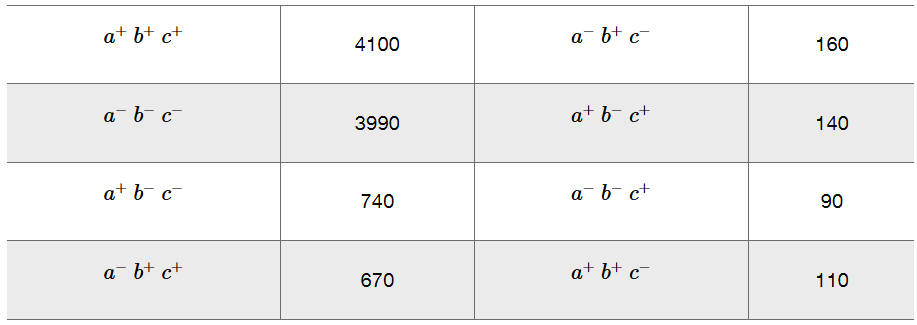
Two theoretical genetic strains of a virus (a⁻b⁻c⁻ and a⁺b⁺c⁺) were used to simultaneously infect a culture of host bacteria. Of 10,000 plaques scored, the following genotypes were observed. Determine the genetic map of these three genes on the viral chromosome. Decide whether the interference was positive or negative.
Table showing counts of eight viral genotypes from co-infection, used to map three genes and assess genetic interference.

검증된 단계별 안내
1
Step 1: Begin by identifying the parental genotypes and recombinant genotypes. The parental genotypes are the most frequent ones observed in the data, which are a⁺b⁺c⁺ (4100 plaques) and a⁻b⁻c⁻ (3990 plaques). The remaining genotypes are recombinants.
Step 2: Calculate the recombination frequencies between each pair of genes. To do this, group the recombinant genotypes based on single crossovers between two genes while keeping the third gene constant. For example, to calculate the recombination frequency between 'a' and 'b', sum the plaques for genotypes that involve a crossover between 'a' and 'b' (e.g., a⁺b⁻c⁺ and a⁻b⁺c⁻), then divide by the total number of plaques (10,000). Repeat this for 'b' and 'c', and 'a' and 'c'.
Step 3: Use the recombination frequencies to determine the relative distances between the genes. The recombination frequency is proportional to the genetic distance in map units (1% recombination = 1 map unit). Arrange the genes in an order that minimizes the total map distance.
Step 4: Check for double crossovers to confirm the gene order. Double crossovers are the least frequent genotypes observed. For example, a⁺b⁻c⁻ and a⁻b⁺c⁺ are likely double crossover genotypes. Verify that the gene order determined in Step 3 is consistent with the observed double crossover frequencies.
Step 5: Determine whether interference is positive or negative. Calculate the coefficient of coincidence (COC) as the ratio of observed double crossovers to expected double crossovers. Interference (I) is then calculated as I = 1 - COC. If I > 0, interference is positive; if I < 0, interference is negative.

비슷한 문제에 대한 검증된 영상 답변:

이 영상 해법은 위 문제에 도움이 된다고 튜터들이 추천한 것입니다.
영상 길이:
3m

주요 개념

질문에 올바르게 답하기 위해 반드시 이해해야 하는 핵심 개념들은 다음과 같습니다.

Genetic Mapping

Genetic mapping is the process of determining the relative positions of genes on a chromosome. It involves analyzing the frequency of recombination between genes during meiosis, which helps to establish their order and distance from one another. In this context, the observed genotypes from the viral plaques will be used to infer the arrangement of the genes a, b, and c on the viral chromosome.
추천 영상:
가이드 코스
11:11
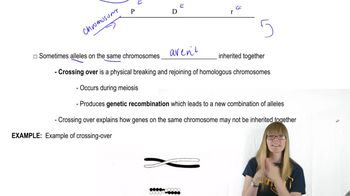
Mapping Overview

Recombination Frequency

Recombination frequency is a measure of how often two genes are separated during the formation of gametes due to crossing over. It is calculated by dividing the number of recombinant offspring by the total number of offspring. This frequency is crucial for constructing genetic maps, as it provides insight into the physical distance between genes; closer genes have lower recombination frequencies.
추천 영상:
가이드 코스
03:51
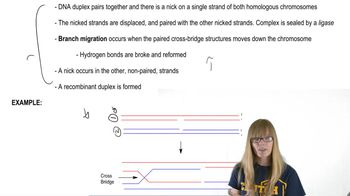
Recombination after Single Strand Breaks

Interference

Interference refers to the phenomenon where the occurrence of one crossover event in a region of a chromosome affects the likelihood of another crossover occurring nearby. Positive interference means that one crossover reduces the chance of another, while negative interference indicates that one crossover increases the likelihood of another. Understanding interference is essential for interpreting the genetic map and the distribution of genotypes observed in the experiment.
추천 영상:
가이드 코스
06:59
RNA Interference