Ch. 8 - Chromosome Mutations: Variation in Number and Arrangement
Klug - Concepts of Genetics 12th Edition
Klug12th EditionConcepts of GeneticsISBN: 9780135564776당신이 사용하는 게 아니라요?교과서 변경
8장, 문제 3

Define these pairs of terms, and distinguish between them.
aneuploidy/ euploidy
monosomy/ trisomy
Patau syndrome/ Edwards syndrome
autopolyploidy/ allopolyploidy
autotetraploid/ amphidiploid
paracentric inversion/ pericentric inversion

검증된 단계별 안내
1
Start by defining aneuploidy and euploidy: Aneuploidy refers to the presence of an abnormal number of chromosomes in a cell (not an exact multiple of the haploid number), while euploidy means having a chromosome number that is an exact multiple of the haploid set.
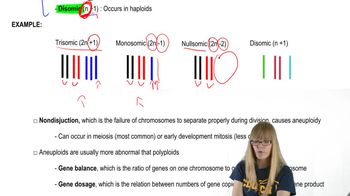
Next, define monosomy and trisomy: Monosomy is a type of aneuploidy where one chromosome is missing from the normal diploid set (2n - 1), whereas trisomy is when there is an extra chromosome present (2n + 1).
Then, explain Patau syndrome and Edwards syndrome: Patau syndrome is caused by trisomy of chromosome 13, characterized by severe intellectual disability and physical abnormalities; Edwards syndrome results from trisomy of chromosome 18, also causing developmental issues but with a different set of clinical features.
After that, distinguish autopolyploidy and allopolyploidy: Autopolyploidy occurs when multiple chromosome sets come from the same species (e.g., chromosome duplication within one species), while allopolyploidy involves combining chromosome sets from different species through hybridization.
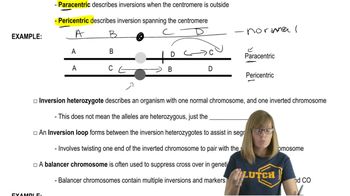
Finally, differentiate between paracentric and pericentric inversions: Paracentric inversion is a chromosome rearrangement that does not include the centromere and involves only one arm of the chromosome, whereas pericentric inversion includes the centromere and involves both arms.

비슷한 문제에 대한 검증된 영상 답변:

이 영상 해법은 위 문제에 도움이 된다고 튜터들이 추천한 것입니다.
영상 길이:
1m
도움이 되었나요?

주요 개념

질문에 올바르게 답하기 위해 반드시 이해해야 하는 핵심 개념들은 다음과 같습니다.

Aneuploidy vs. Euploidy

Aneuploidy refers to the presence of an abnormal number of chromosomes in a cell, such as missing or extra chromosomes, disrupting the normal chromosome set. Euploidy describes cells with complete sets of chromosomes, either the normal diploid number or multiples thereof, maintaining genomic balance.
추천 영상:

Monosomy vs. Trisomy

Monosomy is a type of aneuploidy where one chromosome from a pair is missing, resulting in a single copy instead of two. Trisomy involves having an extra chromosome, making three copies of a particular chromosome, which often leads to developmental disorders.
추천 영상:
가이드 코스
04:17
Traditional vs. Next-Gen

Paracentric Inversion vs. Pericentric Inversion

Paracentric inversion is a chromosome rearrangement where a segment flips within one arm of a chromosome, excluding the centromere. Pericentric inversion includes the centromere and involves flipping a chromosome segment that spans both arms, potentially affecting gene order and function.
추천 영상: