Ch. 8 - Chromosome Mutations: Variation in Number and Arrangement
Klug - Concepts of Genetics 12th Edition
Klug12th EditionConcepts of GeneticsISBN: 9780135564776당신이 사용하는 게 아니라요?교과서 변경
8장, 문제 1d

How do we know that the mutant Bar-eye phenotype in Drosophila is due to a duplicated gene region rather than to a change in the nucleotide sequence of a gene?

검증된 단계별 안내
1
Understand the nature of the Bar-eye phenotype in Drosophila, which is characterized by a reduced number of facets in the compound eye, suggesting a structural change rather than a simple point mutation.
Review genetic and cytogenetic evidence: examine chromosome banding patterns under a microscope to detect duplications or rearrangements in the region associated with the Bar-eye phenotype.
Analyze genetic crosses and inheritance patterns; a duplication often shows dosage effects and can produce dominant phenotypes, whereas a point mutation typically behaves differently in inheritance.
Use molecular techniques such as Southern blotting or DNA sequencing to compare the mutant and wild-type alleles; if the nucleotide sequence is unchanged but the gene copy number is increased, this supports duplication.
Consider gene dosage effects: increased gene copy number from duplication leads to overexpression, which correlates with the Bar-eye phenotype, whereas a nucleotide change would alter gene function without changing copy number.

비슷한 문제에 대한 검증된 영상 답변:

이 영상 해법은 위 문제에 도움이 된다고 튜터들이 추천한 것입니다.
영상 길이:
1m
도움이 되었나요?

주요 개념

질문에 올바르게 답하기 위해 반드시 이해해야 하는 핵심 개념들은 다음과 같습니다.

Gene Duplication

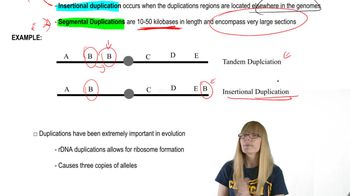
Gene duplication occurs when a segment of DNA containing a gene is copied one or more times in the genome. This can lead to increased gene dosage and altered phenotypes, such as the Bar-eye in Drosophila, where extra copies of a gene region cause changes in eye shape.
추천 영상:

Mutation Types: Structural vs. Sequence Changes

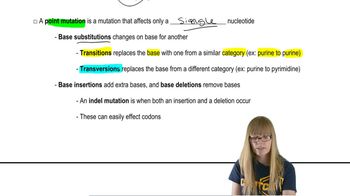
Mutations can involve changes in the DNA sequence (point mutations) or structural changes like duplications, deletions, or inversions. Distinguishing between these helps identify whether a phenotype arises from altered gene function or gene copy number.
추천 영상:
가이드 코스
09:49
Point Mutations

Genetic and Cytogenetic Evidence

Techniques such as genetic mapping, complementation tests, and cytogenetic analysis (e.g., chromosome banding or in situ hybridization) can reveal duplications by showing extra chromosomal material or altered gene dosage, differentiating duplication from simple nucleotide changes.
추천 영상:
가이드 코스
03:45
Descriptive Genetics