Ch. 1 - The Molecular Basis of Heredity, Variation, and Evolution
Sanders - Genetic Analysis: An Integrated Approach 3rd Edition
Sanders3rd EditionGenetic Analysis: An Integrated ApproachISBN: 9780135564172당신이 사용하는 게 아니라요?교과서 변경
1장, 문제 23

Fill in the missing nucleotides (so there are three per block) and the missing amino acid abbreviations in the graphic shown here. 


Diagram showing DNA, mRNA, tRNA, and amino acids for genetics fundamentals.

검증된 단계별 안내
1
Identify the missing nucleotides in the DNA template strand by using the complementary base-pairing rules. For DNA, adenine (A) pairs with thymine (T), and cytosine (C) pairs with guanine (G). Fill in the missing nucleotides in the template strand based on the coding strand provided.
Transcribe the DNA template strand into mRNA. Use the base-pairing rules for transcription: adenine (A) in DNA pairs with uracil (U) in RNA, thymine (T) in DNA pairs with adenine (A) in RNA, and cytosine (C) pairs with guanine (G). Fill in the missing mRNA codons.
Determine the tRNA anticodons that correspond to the mRNA codons. Remember that tRNA anticodons are complementary to the mRNA codons, following the base-pairing rules (A pairs with U, and C pairs with G). Fill in the missing tRNA anticodons.
Use the genetic code table to translate the mRNA codons into their corresponding amino acids. Each codon specifies one amino acid. Fill in the missing amino acid abbreviations (both 3-letter and 1-letter codes).
Double-check your work to ensure that the DNA, mRNA, tRNA, and amino acid sequences are consistent with each other and follow the rules of transcription and translation.

비슷한 문제에 대한 검증된 영상 답변:

이 영상 해법은 위 문제에 도움이 된다고 튜터들이 추천한 것입니다.
영상 길이:
2m
도움이 되었나요?

주요 개념

질문에 올바르게 답하기 위해 반드시 이해해야 하는 핵심 개념들은 다음과 같습니다.

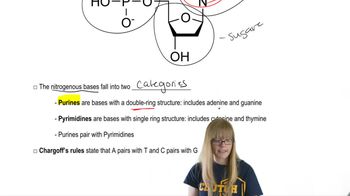
DNA Structure and Function

DNA consists of two strands forming a double helix, with each strand made up of nucleotides. The coding strand contains the sequence that is transcribed into mRNA, while the template strand serves as a guide for RNA polymerase during transcription. Understanding the directionality (5' to 3') of these strands is crucial for accurately filling in missing nucleotides.
추천 영상:

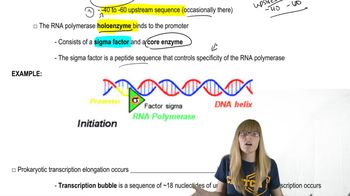
Transcription and mRNA

Transcription is the process by which the genetic information in DNA is copied into mRNA. The mRNA codons are sequences of three nucleotides that correspond to specific amino acids. Recognizing how codons are formed from the DNA template is essential for completing the missing sequences in the question.
추천 영상:
가이드 코스
10:14
Prokaryotic Transcription

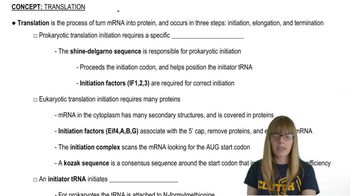
tRNA and Translation

Transfer RNA (tRNA) molecules carry amino acids to the ribosome during translation, matching their anticodons with the mRNA codons. Each tRNA anticodon is complementary to a specific mRNA codon, ensuring the correct amino acid is added to the growing polypeptide chain. Understanding this relationship is key to determining the correct amino acid abbreviations in the graphic.
추천 영상:
가이드 코스
07:58
Translation initiation
관련 실천
교과서 질문

Examine the following figure and answer the following questions.

How many clades are shown in the figure?

583
views
교과서 질문

Suppose a genotype for a protein-producing gene can have any combination of three alleles, A₁, A₂, and A₃.

List all the possible genotypes involving these three alleles.

733
views
교과서 질문

Examine the following figure and answer the following questions.

What characteristics are shared by the mammalian clade and the primate clade? What characteristic distinguishes the primates from other members of the mammalian clade?

538
views
교과서 질문

Suppose a genotype for a protein-producing gene can have any combination of three alleles, A₁, A₂, and A₃.

Each allele produces a protein with a distinct electrophoretic mobility. Allele A₁ has the highest electrophoretic mobility, A₃ has the lowest electrophoretic mobility, and the electrophoretic mobility of A₂ is intermediate between them. Draw the appearance of gel electrophoresis protein bands for each of the possible genotypes. Be sure to label each lane of the gel with the corresponding genotype.

645
views
교과서 질문

Shorter fragments of DNA (those with fewer base pairs) have a higher electrophoretic mobility than larger fragments. Thinking about electrophoresis gels as creating a matrix through which fragments must migrate, briefly explain why the size of a DNA fragment affects its electrophoretic mobility.

817
views
교과서 질문

Examine the following figure and answer the following questions.

What characteristic is shared by all clades in the figure?

536
views