Ch. 1 - The Molecular Basis of Heredity, Variation, and Evolution
Sanders - Genetic Analysis: An Integrated Approach 3rd Edition
Sanders3rd EditionGenetic Analysis: An Integrated ApproachISBN: 9780135564172당신이 사용하는 게 아니라요?교과서 변경
1장, 문제 25

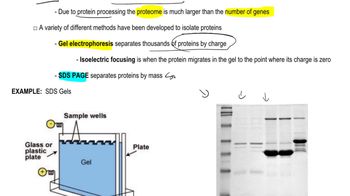
Shorter fragments of DNA (those with fewer base pairs) have a higher electrophoretic mobility than larger fragments. Thinking about electrophoresis gels as creating a matrix through which fragments must migrate, briefly explain why the size of a DNA fragment affects its electrophoretic mobility.

검증된 단계별 안내
1
Understand that electrophoresis is a technique used to separate DNA fragments based on size by applying an electric field to a gel matrix.
Recognize that the gel matrix acts like a sieve, where smaller DNA fragments can move more easily through the pores of the gel compared to larger fragments.
Consider that the electric field causes DNA fragments to migrate towards the positive electrode due to the negative charge of the DNA backbone.
Acknowledge that smaller DNA fragments experience less resistance and can navigate through the gel matrix more quickly than larger fragments, which encounter more friction and obstacles.
Conclude that the size of a DNA fragment affects its electrophoretic mobility because smaller fragments can move faster and further through the gel matrix than larger fragments.

비슷한 문제에 대한 검증된 영상 답변:

이 영상 해법은 위 문제에 도움이 된다고 튜터들이 추천한 것입니다.
영상 길이:
1m
도움이 되었나요?

주요 개념

질문에 올바르게 답하기 위해 반드시 이해해야 하는 핵심 개념들은 다음과 같습니다.

Electrophoresis

Electrophoresis is a laboratory technique used to separate charged particles, such as DNA fragments, based on their size and charge. In this process, an electric field is applied to a gel matrix, causing the DNA fragments to migrate towards the positive electrode. Smaller fragments move more easily through the gel's pores, resulting in faster migration compared to larger fragments, which encounter more resistance.
추천 영상:

Gel Matrix

The gel matrix, typically made of agarose or polyacrylamide, serves as a sieve that affects the movement of DNA fragments during electrophoresis. The size of the pores in the gel determines how easily different sized fragments can pass through. Smaller DNA fragments can navigate through these pores more efficiently, while larger fragments are hindered, leading to differences in their migration rates.
추천 영상:

Molecular Size and Mobility

Molecular size directly influences the mobility of DNA fragments during electrophoresis. Smaller fragments have a higher electrophoretic mobility because they can travel through the gel matrix with less friction and obstruction. In contrast, larger fragments experience greater resistance due to their size, resulting in slower movement through the gel, which is why size is a critical factor in electrophoretic separation.
추천 영상:
가이드 코스
03:45
Descriptive Genetics
관련 실천
교과서 질문

Suppose a genotype for a protein-producing gene can have any combination of three alleles, A₁, A₂, and A₃.

List all the possible genotypes involving these three alleles.

733
views
교과서 질문

If one is constructing a phylogeny of reptiles using DNA sequence data, which taxon (birds, mammals, amphibians, or fish) might be suitable to use as an outgroup?

1377
views
교과서 질문

Suppose a genotype for a protein-producing gene can have any combination of three alleles, A₁, A₂, and A₃.

Each allele produces a protein with a distinct electrophoretic mobility. Allele A₁ has the highest electrophoretic mobility, A₃ has the lowest electrophoretic mobility, and the electrophoretic mobility of A₂ is intermediate between them. Draw the appearance of gel electrophoresis protein bands for each of the possible genotypes. Be sure to label each lane of the gel with the corresponding genotype.

645
views
교과서 질문

Four nucleic-acid samples are analyzed to determine the percentages of the nucleotides they contain. Survey the data in the table to determine which samples are DNA and which are RNA, and specify whether each sample is double-stranded or single-stranded. Justify each answer.

[A table of nucleotide percentages appears below the problem]


1328
views
교과서 질문

What is meant by the term homology? How is that different from the meaning of homoplasmy?

1087
views
교과서 질문

Fill in the missing nucleotides (so there are three per block) and the missing amino acid abbreviations in the graphic shown here. 


769
views