Ch. 10 - Eukaryotic Chromosome Abnormalities and Molecular Organization
Sanders - Genetic Analysis: An Integrated Approach 3rd Edition
Sanders3rd EditionGenetic Analysis: An Integrated ApproachISBN: 9780135564172당신이 사용하는 게 아니라요?교과서 변경
10장, 문제 29a

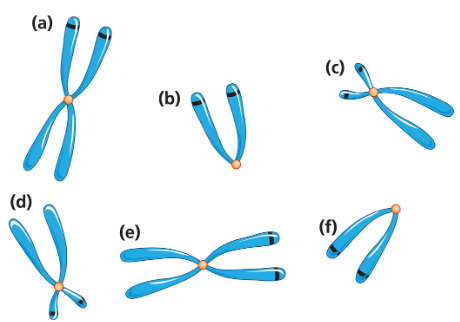
A eukaryote with a diploid number of 2n=6 carries the chromosomes shown below and labeled (a) to (f).
Illustration of six chromosomes labeled (a) to (f) in a eukaryote, depicting their structure for educational purposes.
Carefully examine and redraw these chromosomes in any valid metaphase I alignment. Draw and label the metaphase plate, and label each chromosome with its assigned letter. 

검증된 단계별 안내
1
Understand the problem: The organism has a diploid number of 2n=6, meaning there are 6 chromosomes in total, or 3 homologous pairs. Each homologous pair consists of one chromosome inherited from each parent. In metaphase I of meiosis, homologous chromosomes align at the metaphase plate in pairs, and their orientation is random.
Identify the homologous pairs: Examine the given chromosomes (a) to (f) and determine which chromosomes are homologous based on their size, shape, and banding patterns. Group them into three pairs.
Draw the metaphase plate: Represent the metaphase plate as a central line. Arrange the homologous pairs on either side of the metaphase plate, ensuring that one chromosome from each pair is on one side and its homolog is on the opposite side. Randomly assign the orientation of each pair, as this reflects independent assortment.
Label the chromosomes: Clearly label each chromosome with its assigned letter (a, b, c, etc.) to indicate their identity. Ensure that homologous chromosomes are labeled correctly and positioned opposite each other.
Review the alignment: Double-check that all six chromosomes are accounted for, that homologous pairs are correctly aligned, and that the arrangement reflects the random orientation characteristic of metaphase I. This ensures the drawing is accurate and complete.

비슷한 문제에 대한 검증된 영상 답변:

이 영상 해법은 위 문제에 도움이 된다고 튜터들이 추천한 것입니다.
영상 길이:
2m
도움이 되었나요?

주요 개념

질문에 올바르게 답하기 위해 반드시 이해해야 하는 핵심 개념들은 다음과 같습니다.

Eukaryotic Cell Structure

Eukaryotic cells are characterized by their complex structure, including a defined nucleus that houses the cell's genetic material. In the context of genetics, understanding eukaryotic cells is essential as they contain multiple linear chromosomes, which undergo various stages of cell division, including meiosis, where genetic recombination occurs.
추천 영상:
가이드 코스
07:10
Chromosome Structure

Meiosis and Metaphase I

Meiosis is a specialized form of cell division that reduces the chromosome number by half, resulting in gametes. During Metaphase I, homologous chromosomes align at the metaphase plate, and this alignment is crucial for ensuring that each daughter cell receives one chromosome from each pair. Understanding this process is vital for accurately redrawing the chromosome alignment.
추천 영상:

Chromosome Labeling and Homologous Pairs

In genetics, chromosomes are often labeled to identify specific pairs and their characteristics. Homologous chromosomes are pairs of chromosomes that have the same genes but may carry different alleles. Properly labeling chromosomes during metaphase I helps in visualizing genetic variation and understanding inheritance patterns.
추천 영상:
가이드 코스
10:35
Human Sex Chromosomes
관련 실천
교과서 질문

Human chromosome 5 and the corresponding chromosomes from chimpanzee, gorilla, and orangutan are shown here. Describe any structural differences you see in the other primate chromosomes in relation to the human chromosome.

642
views
교과서 질문

A eukaryote with a diploid number of 2n=6 carries the chromosomes shown below and labeled (a) to (f).


Explain how you determined the correct alignment of homologous chromosomes on opposite sides of the metaphase plate. 

498
views
교과서 질문

A small population of deer living on an isolated island is separated for many generations from a mainland deer population. The populations retain the same number of chromosomes but hybrids are infertile. One chromosome (shown here) has a different banding pattern in the island population than in the mainland population.

In a mainland–island hybrid deer, recombination takes place in band q1 of the homologous chromosomes. Draw the gametes that result from this event.

506
views
교과서 질문

For the following crosses, determine as accurately as possible the genotypes of each parent, the parent in whom nondisjunction occurs, and whether nondisjunction takes place in the first or second meiotic division. Both color blindness and hemophilia, a blood-clotting disorder, are X-linked recessive traits. In each case, assume the parents have normal karyotypes.

A man and a woman who each has the wild-type phenotype have a son with Klinefelter syndrome (XXY) who has hemophilia.

509
views
교과서 질문

A small population of deer living on an isolated island is separated for many generations from a mainland deer population. The populations retain the same number of chromosomes but hybrids are infertile. One chromosome (shown here) has a different banding pattern in the island population than in the mainland population.

Suppose that 40% of all meioses in mainland–island hybrids involve recombination somewhere in the chromosome region between q2.1 and p2. What proportion of the gametes of hybrid deer are viable? What is the cause of the decreased proportion of viable gametes in hybrids relative to the parental populations?

554
views
교과서 질문

A small population of deer living on an isolated island is separated for many generations from a mainland deer population. The populations retain the same number of chromosomes but hybrids are infertile. One chromosome (shown here) has a different banding pattern in the island population than in the mainland population.

Draw the synapsis of these homologs during prophase I in hybrids produced from the cross of mainland with island deer.

519
views