Ch. 10 - Eukaryotic Chromosome Abnormalities and Molecular Organization
Sanders - Genetic Analysis: An Integrated Approach 3rd Edition
Sanders3rd EditionGenetic Analysis: An Integrated ApproachISBN: 9780135564172당신이 사용하는 게 아니라요?교과서 변경
10장, 문제 15c

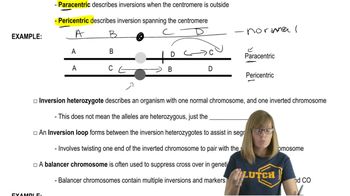
A normal chromosome and its homolog carrying a paracentric inversion are shown here. The dot (·) represents the centromere.
Normal    ABC • DEFGHIJK
Inversion  abc • djihgfe
Assume a crossover takes place in the region between A and B. Identify the gametes that are formed by this crossover event, and indicate which, if any, gametes are viable.

검증된 단계별 안내
1
Understand the problem: A paracentric inversion is a chromosomal rearrangement where a segment of a chromosome is inverted but does not include the centromere. Here, the normal chromosome and its homolog with the inversion are given. A crossover occurs between genes A and B, and we need to determine the resulting gametes and their viability.
Analyze the crossover event: During meiosis, homologous chromosomes align and may undergo crossing over. In this case, the crossover occurs between the normal chromosome (ABC • DEFGHIJK) and the inverted chromosome (abc • djihgfe). This will result in recombinant chromatids with altered gene arrangements.
Determine the structure of recombinant chromatids: After the crossover, the recombinant chromatids will contain a mix of normal and inverted segments. This can lead to the formation of dicentric (two centromeres) or acentric (no centromere) chromatids, which are structurally abnormal.
Assess the viability of gametes: Gametes with dicentric chromatids are typically inviable because the dicentric bridge breaks during anaphase I of meiosis. Similarly, gametes with acentric chromatids are inviable because they lack a centromere and cannot be properly segregated. Only gametes with normal or inversion chromosomes (non-recombinant) are viable.
Summarize the outcome: The viable gametes will be those that retain the original normal chromosome (ABC • DEFGHIJK) or the inversion chromosome (abc • djihgfe). Recombinant gametes resulting from the crossover event are inviable due to structural abnormalities.

비슷한 문제에 대한 검증된 영상 답변:

이 영상 해법은 위 문제에 도움이 된다고 튜터들이 추천한 것입니다.
영상 길이:
4m
도움이 되었나요?

주요 개념

질문에 올바르게 답하기 위해 반드시 이해해야 하는 핵심 개념들은 다음과 같습니다.

Chromosomal Inversion

A chromosomal inversion occurs when a segment of a chromosome is reversed end to end. In the case of a paracentric inversion, the inversion does not include the centromere. This structural alteration can affect gene expression and recombination during meiosis, particularly when crossovers occur within the inverted region, leading to potential formation of nonviable gametes.
추천 영상:

Crossover and Recombination

Crossover is a genetic process that occurs during meiosis where homologous chromosomes exchange segments of genetic material. This recombination can create new allele combinations in gametes. The location of the crossover is crucial, as it can lead to viable or nonviable gametes depending on whether the crossover occurs within a normal or inverted chromosome segment.
추천 영상:
가이드 코스
03:51
Recombination after Single Strand Breaks

Viability of Gametes

The viability of gametes refers to their ability to develop into a functional organism after fertilization. In the context of chromosomal inversions, certain gametes produced from crossovers may carry duplications or deletions of genetic material, rendering them nonviable. Understanding which gametes are viable requires analyzing the genetic content resulting from the crossover event.
추천 영상:
가이드 코스
21:21
Gamete Development
관련 실천
교과서 질문

A normal chromosome and its homolog carrying a paracentric inversion are shown here. The dot (·) represents the centromere.

Normal    ABC • DEFGHIJK

Inversion  abc • djihgfe

Assume a crossover takes place in the region between F and G. Identify the gametes that are formed following this crossover, and indicate which, if any, gametes are viable.

721
views
교과서 질문

The accompanying chromosome diagram represents a eukaryotic chromosome prepared with Giemsa stain. Indicate the heterochromatic and euchromatic regions of the chromosome, and label the chromosome's centromeric and telomeric regions.

Why are expressed genes not found in the telomeric region of chromosomes?

560
views
교과서 질문

A normal chromosome and its homolog carrying a paracentric inversion are shown here. The dot (·) represents the centromere.

Normal    ABC • DEFGHIJK

Inversion  abc • djihgfe

Diagram the alignment of chromosomes during prophase I.

456
views
교과서 질문

Dr. Ara B. Dopsis has an idea he thinks will be a boon to agriculture. He wants to create the 'pomato,' a hybrid between a tomato (Lycopersicon esculentum) that has 12 chromosomes and a potato (Solanum tuberosum) that has 48 chromosomes. Dr. Dopsis is hoping his new pomato will have tuber growth like a potato and the fruit production of a tomato. He joins a haploid gamete from each species to form a hybrid and then induces doubling of chromosome number.

Can Dr. Dopsis be sure the polyploid will have the characteristics he wants? Why or why not?

456
views
교과서 질문

The accompanying chromosome diagram represents a eukaryotic chromosome prepared with Giemsa stain. Indicate the heterochromatic and euchromatic regions of the chromosome, and label the chromosome's centromeric and telomeric regions.

Do you expect the centromeric region to contain heterochromatin? Why or why not?

477
views
교과서 질문

The accompanying chromosome diagram represents a eukaryotic chromosome prepared with Giemsa stain. Indicate the heterochromatic and euchromatic regions of the chromosome, and label the chromosome's centromeric and telomeric regions.

What term best describes the shape of this chromosome?

528
views