Ch. 10 - Eukaryotic Chromosome Abnormalities and Molecular Organization
Sanders - Genetic Analysis: An Integrated Approach 3rd Edition
Sanders3rd EditionGenetic Analysis: An Integrated ApproachISBN: 9780135564172당신이 사용하는 게 아니라요?교과서 변경
10장, 문제 16a

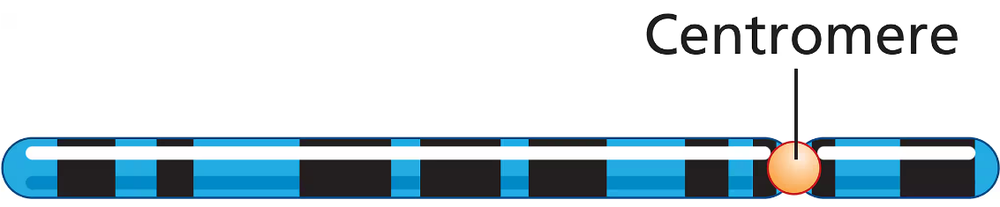
The accompanying chromosome diagram represents a eukaryotic chromosome prepared with Giemsa stain. Indicate the heterochromatic and euchromatic regions of the chromosome, and label the chromosome's centromeric and telomeric regions.
Diagram of a eukaryotic chromosome showing centromere, telomeres, and labeled heterochromatic and euchromatic regions.
What term best describes the shape of this chromosome?

검증된 단계별 안내
1
Examine the chromosome diagram and identify the darker-stained regions. These regions are heterochromatic, as heterochromatin is more densely packed and stains more intensely with Giemsa stain.
Identify the lighter-stained regions on the chromosome. These regions are euchromatic, as euchromatin is less densely packed and stains less intensely.
Locate the centromere on the chromosome. The centromere is the constricted region that divides the chromosome into two arms and is essential for proper chromosome segregation during cell division.
Identify the telomeric regions at the ends of the chromosome. Telomeres are specialized structures that protect the ends of linear chromosomes from degradation.
Determine the shape of the chromosome based on the relative lengths of the arms on either side of the centromere. For example, if the arms are of equal length, the chromosome is metacentric; if one arm is significantly shorter, it may be submetacentric, acrocentric, or telocentric.

비슷한 문제에 대한 검증된 영상 답변:

이 영상 해법은 위 문제에 도움이 된다고 튜터들이 추천한 것입니다.
영상 길이:
2m
도움이 되었나요?

주요 개념

질문에 올바르게 답하기 위해 반드시 이해해야 하는 핵심 개념들은 다음과 같습니다.

Eukaryotic Chromosome Structure

Eukaryotic chromosomes are linear structures composed of DNA and proteins, organized into chromatin. They consist of euchromatin, which is less condensed and transcriptionally active, and heterochromatin, which is more condensed and typically transcriptionally inactive. Understanding this structure is essential for identifying the different regions of the chromosome in the provided diagram.
추천 영상:
가이드 코스
07:10
Chromosome Structure

Centromere and Telomere

The centromere is a specialized region of a chromosome that plays a crucial role during cell division, serving as the attachment point for spindle fibers. Telomeres are repetitive nucleotide sequences at the ends of chromosomes that protect them from degradation and prevent fusion with neighboring chromosomes. Recognizing these regions is vital for accurately labeling the chromosome in the question.
추천 영상:
가이드 코스
08:38
Telomeres and Telomerase

Chromosome Morphology

Chromosome morphology refers to the shape and structure of chromosomes, which can vary based on the position of the centromere. Common shapes include metacentric (centromere in the middle), submetacentric (centromere slightly off-center), acrocentric (centromere near one end), and telocentric (centromere at the end). Identifying the correct term for the chromosome's shape is essential for answering the question accurately.
추천 영상:
가이드 코스
07:10
Chromosome Structure
관련 실천
교과서 질문

A normal chromosome and its homolog carrying a paracentric inversion are shown here. The dot (·) represents the centromere.

Normal    ABC • DEFGHIJK

Inversion  abc • djihgfe

Assume a crossover takes place in the region between F and G. Identify the gametes that are formed following this crossover, and indicate which, if any, gametes are viable.

721
views
교과서 질문

The accompanying chromosome diagram represents a eukaryotic chromosome prepared with Giemsa stain. Indicate the heterochromatic and euchromatic regions of the chromosome, and label the chromosome's centromeric and telomeric regions.

Why are expressed genes not found in the telomeric region of chromosomes?

560
views
교과서 질문

A normal chromosome and its homolog carrying a paracentric inversion are shown here. The dot (·) represents the centromere.

Normal    ABC • DEFGHIJK

Inversion  abc • djihgfe

Diagram the alignment of chromosomes during prophase I.

456
views
교과서 질문

The accompanying chromosome diagram represents a eukaryotic chromosome prepared with Giemsa stain. Indicate the heterochromatic and euchromatic regions of the chromosome, and label the chromosome's centromeric and telomeric regions.

Are you more likely to find the DNA sequence encoding the digestive enzyme amylase in a heterochromatic, euchromatic, centromeric, or telomeric region? Explain your reasoning.

561
views
교과서 질문

A normal chromosome and its homolog carrying a paracentric inversion are shown here. The dot (·) represents the centromere.

Normal    ABC • DEFGHIJK

Inversion  abc • djihgfe

Assume a crossover takes place in the region between A and B. Identify the gametes that are formed by this crossover event, and indicate which, if any, gametes are viable.

464
views
교과서 질문

The accompanying chromosome diagram represents a eukaryotic chromosome prepared with Giemsa stain. Indicate the heterochromatic and euchromatic regions of the chromosome, and label the chromosome's centromeric and telomeric regions.

Do you expect the centromeric region to contain heterochromatin? Why or why not?

477
views