Ch. 10 - Eukaryotic Chromosome Abnormalities and Molecular Organization
Sanders - Genetic Analysis: An Integrated Approach 3rd Edition
Sanders3rd EditionGenetic Analysis: An Integrated ApproachISBN: 9780135564172당신이 사용하는 게 아니라요?교과서 변경
10장, 문제 1g

Give descriptions for the following terms:
Nucleosome

검증된 단계별 안내
1
A nucleosome is the fundamental unit of chromatin structure in eukaryotic cells, responsible for packaging DNA into a compact form.
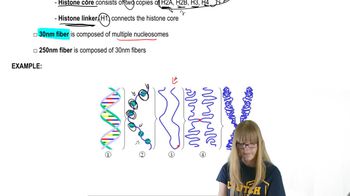
It consists of a segment of DNA wrapped around a core of histone proteins. Specifically, the DNA wraps approximately 1.65 turns around the histone octamer.
The histone octamer is composed of eight histone proteins: two copies each of H2A, H2B, H3, and H4.
Linker DNA connects adjacent nucleosomes, and the histone H1 protein helps stabilize the structure by binding to the linker DNA and the nucleosome core.
Nucleosomes play a critical role in regulating gene expression by controlling the accessibility of DNA to transcription factors and other proteins involved in gene regulation.

비슷한 문제에 대한 검증된 영상 답변:

이 영상 해법은 위 문제에 도움이 된다고 튜터들이 추천한 것입니다.
영상 길이:
3m
도움이 되었나요?

주요 개념

질문에 올바르게 답하기 위해 반드시 이해해야 하는 핵심 개념들은 다음과 같습니다.

Nucleosome Structure

A nucleosome is the fundamental unit of chromatin, consisting of a segment of DNA wrapped around a core of histone proteins. This structure resembles 'beads on a string,' where the DNA is the string and the nucleosomes are the beads. Each nucleosome typically contains about 147 base pairs of DNA and is crucial for the compaction of DNA within the nucleus.
추천 영상:
가이드 코스
07:10
Chromosome Structure

Role in Gene Regulation

Nucleosomes play a significant role in gene regulation by controlling access to DNA. The positioning and modification of nucleosomes can either expose or obscure specific gene regions, influencing transcription. This dynamic regulation is essential for cellular differentiation and response to environmental signals.
추천 영상:
가이드 코스
09:22
Review of Regulation

Histone Modifications

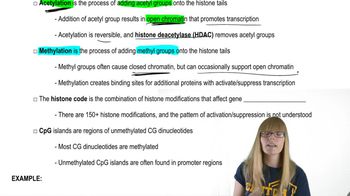
Histone proteins within nucleosomes can undergo various post-translational modifications, such as acetylation, methylation, and phosphorylation. These modifications can alter the interaction between DNA and histones, affecting chromatin structure and function. Such changes are critical for processes like DNA repair, replication, and transcriptional activation or repression.
추천 영상:
가이드 코스
07:55
Histone Protein Modifications