Ch. 11 - Gene Mutation, DNA Repair, and Homologous Recombination
Sanders - Genetic Analysis: An Integrated Approach 3rd Edition
Sanders3rd EditionGenetic Analysis: An Integrated ApproachISBN: 9780135564172당신이 사용하는 게 아니라요?교과서 변경
11장, 문제 4

What are the differences between a synonymous mutation, a missense mutation, and a nonsense mutation?

검증된 단계별 안내
1
Understand that mutations are changes in the DNA sequence that can affect protein synthesis.
A synonymous mutation is a change in the DNA sequence that does not alter the amino acid sequence of the protein. This occurs because of the redundancy in the genetic code, where multiple codons can code for the same amino acid.
A missense mutation is a change in the DNA sequence that results in the substitution of one amino acid for another in the protein. This can affect the protein's function, depending on the role of the altered amino acid.
A nonsense mutation is a change in the DNA sequence that converts a codon encoding an amino acid into a stop codon. This results in premature termination of protein synthesis, often leading to a nonfunctional protein.
Consider the impact of each type of mutation on protein function: synonymous mutations typically have no effect, missense mutations can have varying effects, and nonsense mutations often lead to loss of function.

비슷한 문제에 대한 검증된 영상 답변:

이 영상 해법은 위 문제에 도움이 된다고 튜터들이 추천한 것입니다.
영상 길이:
3m
도움이 되었나요?

주요 개념

질문에 올바르게 답하기 위해 반드시 이해해야 하는 핵심 개념들은 다음과 같습니다.

Synonymous Mutation

A synonymous mutation is a change in the DNA sequence that does not alter the amino acid sequence of the resulting protein. This occurs because multiple codons can code for the same amino acid due to the redundancy in the genetic code. As a result, synonymous mutations are often considered neutral, as they do not affect the protein's function.
추천 영상:
가이드 코스
09:49
Point Mutations

Missense Mutation

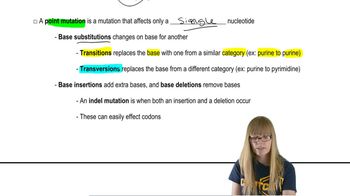
A missense mutation is a type of point mutation where a single nucleotide change results in the substitution of one amino acid for another in the protein. This can potentially alter the protein's function, depending on the role of the affected amino acid in the protein's structure or activity. Missense mutations can be classified as benign, harmful, or beneficial based on their effects on the organism.
추천 영상:
가이드 코스
09:49
Point Mutations

Nonsense Mutation

A nonsense mutation is a mutation that converts a codon encoding an amino acid into a stop codon, leading to premature termination of protein synthesis. This results in a truncated protein that is often nonfunctional. Nonsense mutations can have severe consequences for cellular function and are typically associated with genetic disorders.
추천 영상:
가이드 코스
09:49
Point Mutations
관련 실천
교과서 질문

What is the difference between a transition mutation and a transversion mutation?

1141
views
교과서 질문

Nitrous acid and 5-bromodeoxyuracil (BrdU) alter DNA by different mechanisms. What type of mutation does each compound produce?

603
views
교과서 질문

In March 2011 an earthquake measuring approximately 9.0 on the Richter scale struck Fukushima, Japan. Several nuclear reactors at the Fukushima Daichii Nuclear Power Plant were damaged, and nuclear core meltdown occurred. A massive release of radiation accompanied damage to the plant, and 5 years later the incidence of thyroid cancer in children exposed to the radiation was determined to be well over 100 times more frequent than expected without radiation exposure. DNA damage and mutations resulting from radiation exposure are suspected of causing this increased cancer rate. What gene discussed in this chapter might be responsible for pausing the cell cycle of dividing cells long enough for radiation-induced damage to be repaired in cells?

414
views
교과서 질문

UV irradiation causes damage to bacterial DNA. What kind of damage is frequently caused and how does photolyase repair the damage?

788
views
교과서 질문

For the retinal cancer retinoblastoma, the inheritance of one mutated copy of RB1 from one of the parents is often referred to as a mutation that produces a 'dominant predisposition to cancer.' This means that the first mutation does not produce cancer but makes it very likely that cancer will develop. Define the 'two-hit hypothesis' for retinoblastoma.

521
views
교과서 질문

In March 2011 an earthquake measuring approximately 9.0 on the Richter scale struck Fukushima, Japan. Several nuclear reactors at the Fukushima Daichii Nuclear Power Plant were damaged, and nuclear core meltdown occurred. A massive release of radiation accompanied damage to the plant, and 5 years later the incidence of thyroid cancer in children exposed to the radiation was determined to be well over 100 times more frequent than expected without radiation exposure. DNA damage and mutations resulting from radiation exposure are suspected of causing this increased cancer rate. Do you think it is possible that significant increases in the incidence of other types of cancer will occur in the future among people who were exposed to the Fukushima radiation? Why?

466
views