Nitrous acid and 5-bromodeoxyuracil (BrdU) alter DNA by different mechanisms. What type of mutation does each compound produce?
Ch. 11 - Gene Mutation, DNA Repair, and Homologous Recombination

11장, 문제 3
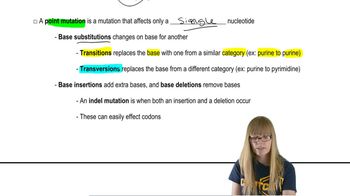
What is the difference between a transition mutation and a transversion mutation?
검증된 단계별 안내1
Understand that mutations are changes in the DNA sequence, and they can be classified based on the type of nucleotide change.
Recognize that a transition mutation is a type of point mutation where a purine is replaced with another purine (A ↔ G) or a pyrimidine is replaced with another pyrimidine (C ↔ T).
Identify that a transversion mutation is another type of point mutation where a purine is replaced with a pyrimidine or vice versa (A or G ↔ C or T).
Note that transitions are more common than transversions because they involve less drastic changes in the DNA structure.
Consider the implications of these mutations: transitions may have less impact on the protein function compared to transversions, which can lead to more significant changes in the amino acid sequence.

비슷한 문제에 대한 검증된 영상 답변:
이 영상 해법은 위 문제에 도움이 된다고 튜터들이 추천한 것입니다.
영상 길이:
2m도움이 되었나요?
주요 개념
질문에 올바르게 답하기 위해 반드시 이해해야 하는 핵심 개념들은 다음과 같습니다.
Transition Mutation
A transition mutation is a type of point mutation where a purine base (adenine or guanine) is replaced by another purine, or a pyrimidine base (cytosine or thymine) is replaced by another pyrimidine. This type of mutation is more common than transversion mutations and often has less impact on the protein structure, as it maintains the same class of nucleotide.
추천 영상:
가이드 코스
Point Mutations
Transversion Mutation
A transversion mutation is another type of point mutation, but it involves the substitution of a purine for a pyrimidine or vice versa. This means that adenine or guanine can be replaced by cytosine or thymine, leading to a more significant change in the DNA sequence. Transversions are less frequent than transitions and can have a greater impact on the resulting protein.
추천 영상:
가이드 코스
Point Mutations
Impact on Protein Function
Both transition and transversion mutations can affect protein function, but their impacts can vary. Transition mutations are often less disruptive due to the preservation of the nucleotide class, while transversions can lead to more drastic changes in amino acid sequences, potentially altering protein structure and function. Understanding these differences is crucial for predicting the effects of mutations in genetic studies.
추천 영상:
가이드 코스
Proteins
관련 실천
교과서 질문
603
views
교과서 질문
Identify two general ways chemical mutagens can alter DNA. Give examples of these two mechanisms.
655
views
교과서 질문
What are the differences between a synonymous mutation, a missense mutation, and a nonsense mutation?
916
views
교과서 질문
UV irradiation causes damage to bacterial DNA. What kind of damage is frequently caused and how does photolyase repair the damage?
788
views
교과서 질문
For the retinal cancer retinoblastoma, the inheritance of one mutated copy of RB1 from one of the parents is often referred to as a mutation that produces a 'dominant predisposition to cancer.' This means that the first mutation does not produce cancer but makes it very likely that cancer will develop. Define the 'two-hit hypothesis' for retinoblastoma.
521
views