Ch. 12 - Regulation of Gene Expression in Bacteria and Bacteriophage
Sanders - Genetic Analysis: An Integrated Approach 3rd Edition
Sanders3rd EditionGenetic Analysis: An Integrated ApproachISBN: 9780135564172당신이 사용하는 게 아니라요?교과서 변경
12장, 문제 30b

For an E. coli strain with the lac operon genotype I⁺ P⁺ O⁺ Z⁺ Y⁺, identify the level of transcription of the operon genes in each growth medium listed. Specify transcription as 'none,' 'basal,' or 'activated' for each medium, and provide an explanation to justify your answer.
Growth medium contains glucose but no lactose.

검증된 단계별 안내
1
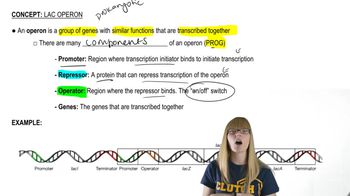
Understand the lac operon system: The lac operon in E. coli is a set of genes (Z and Y) involved in lactose metabolism. It is regulated by the presence or absence of lactose and glucose. The key components are: (1) the repressor protein (I), (2) the promoter (P), (3) the operator (O), and (4) the structural genes (Z and Y).
Analyze the genotype I⁺ P⁺ O⁺ Z⁺ Y⁺: This genotype indicates that all components of the lac operon are functional. The repressor protein (I⁺) can bind to the operator (O⁺) to block transcription in the absence of lactose. The promoter (P⁺) is functional, allowing RNA polymerase to bind and initiate transcription when the operon is activated.
Consider the growth medium: The medium contains glucose but no lactose. Glucose represses the lac operon through catabolite repression, a process mediated by low levels of cyclic AMP (cAMP). Low cAMP levels prevent the formation of the cAMP-CAP complex, which is required for activated transcription of the lac operon.
Determine the effect of no lactose: In the absence of lactose, the repressor protein (I⁺) binds to the operator (O⁺), physically blocking RNA polymerase from transcribing the Z and Y genes. This results in no transcription of the operon.
Conclude the transcription level: Since glucose is present (causing catabolite repression) and lactose is absent (allowing the repressor to block transcription), the transcription level of the lac operon genes is 'none.'

비슷한 문제에 대한 검증된 영상 답변:

이 영상 해법은 위 문제에 도움이 된다고 튜터들이 추천한 것입니다.
영상 길이:
3m

주요 개념

질문에 올바르게 답하기 위해 반드시 이해해야 하는 핵심 개념들은 다음과 같습니다.

Lac Operon Structure

The lac operon in E. coli consists of several key components: the promoter (P), operator (O), and structural genes (Z and Y) that code for enzymes involved in lactose metabolism. The I gene produces a repressor that binds to the operator, preventing transcription when lactose is absent. Understanding this structure is essential for analyzing how the operon responds to different growth media.
추천 영상:
가이드 코스
04:27
Lac Operon Overview

Glucose Effect

In the presence of glucose, E. coli prefers to utilize it over lactose due to catabolite repression. This mechanism involves the inhibition of the lac operon by the cAMP-CAP complex, which is not formed when glucose is abundant. Therefore, when glucose is present, the transcription of the lac operon is significantly reduced, leading to a low level of expression of the operon genes.
추천 영상:
가이드 코스
03:38
Maternal Effect

Transcription Levels

Transcription levels can be categorized as 'none,' 'basal,' or 'activated.' 'None' indicates no transcription occurs, 'basal' refers to minimal transcription under certain conditions, and 'activated' signifies high transcription levels due to the presence of inducers. In the context of the lac operon, understanding these levels helps determine how the operon responds to the absence of lactose and the presence of glucose.
추천 영상:
가이드 코스
09:16
Eukaryotic Transcription
관련 실천
교과서 질문

How could antisense RNA be used as an antibiotic? What types of genes would you target using this scheme?

529
views
교과서 질문

The function of tRNA synthetases is to attach amino acids to tRNAs. Suppose the tRNA synthetase responsible for attaching tryptophan to tRNA is mutated in a bacterial strain, with the result that the tRNA synthetase functions at about 15% of the efficiency of the wild-type tRNA synthetase.

How would this mutation affect attenuation of the tryptophan operon? Explain your answer.

468
views
교과서 질문

The bacterial insertion sequence IS10 uses antisense RNA to regulate translation of the mRNA that produces the enzyme transposase, which is required for insertion sequence transposition. Transcription of the antisense RNA gene is controlled by POUT, which is more than 10 times more efficient at transcription than the PIN promoter, which controls transposase gene transcription.

If a mutation of PIN eliminates its ability to function in transcription, what is the likely effect on the transposition of IS10?

453
views
교과서 질문

For an E. coli strain with the lac operon genotype I⁺ P⁺ O⁺ Z⁺ Y⁺, identify the level of transcription of the operon genes in each growth medium listed. Specify transcription as 'none,' 'basal,' or 'activated' for each medium, and provide an explanation to justify your answer.

Growth medium contains lactose but no glucose.

839
views
교과서 질문

For an E. coli strain with the lac operon genotype I⁺ P⁺ O⁺ Z⁺ Y⁺, identify the level of transcription of the operon genes in each growth medium listed. Specify transcription as 'none,' 'basal,' or 'activated' for each medium, and provide an explanation to justify your answer.

Growth medium contains lactose and glucose.

828
views
교과서 질문

The bacterial insertion sequence IS10 uses antisense RNA to regulate translation of the mRNA that produces the enzyme transposase, which is required for insertion sequence transposition. Transcription of the antisense RNA gene is controlled by POUT, which is more than 10 times more efficient at transcription than the PIN promoter, which controls transposase gene transcription.

If a mutation reduced the transcriptional efficiency of POUT so as to be equal to that of PIN, what is the likely effect on the transposition of IS10?

652
views