Ch. 12 - Regulation of Gene Expression in Bacteria and Bacteriophage
Sanders - Genetic Analysis: An Integrated Approach 3rd Edition
Sanders3rd EditionGenetic Analysis: An Integrated ApproachISBN: 9780135564172당신이 사용하는 게 아니라요?교과서 변경
12장, 문제 29a

The bacterial insertion sequence IS10 uses antisense RNA to regulate translation of the mRNA that produces the enzyme transposase, which is required for insertion sequence transposition. Transcription of the antisense RNA gene is controlled by POUT, which is more than 10 times more efficient at transcription than the PIN promoter, which controls transposase gene transcription.
If a mutation reduced the transcriptional efficiency of POUT so as to be equal to that of PIN, what is the likely effect on the transposition of IS10?

검증된 단계별 안내
1
Understand the role of antisense RNA in regulating transposase production. Antisense RNA binds to the mRNA of the transposase gene, preventing its translation into the transposase enzyme. This regulation ensures controlled transposition activity of IS10.
Recognize the significance of the POUT promoter. POUT drives the transcription of the antisense RNA gene and is normally much more efficient than the PIN promoter, which drives the transcription of the transposase gene. This imbalance ensures that antisense RNA is produced in higher quantities, effectively suppressing transposase production.
Analyze the mutation described in the problem. The mutation reduces the transcriptional efficiency of POUT, making it equal to that of PIN. This means that the production of antisense RNA will decrease, while the production of transposase mRNA remains unchanged.
Predict the effect of reduced antisense RNA levels. With less antisense RNA available to bind to transposase mRNA, more transposase enzyme will be produced. This increase in transposase levels will likely lead to higher rates of IS10 transposition.
Conclude the likely outcome. The mutation disrupts the regulatory balance between antisense RNA and transposase mRNA, leading to increased transposition activity of IS10, which could have significant effects on the bacterial genome, such as increased genetic instability or altered gene expression.

비슷한 문제에 대한 검증된 영상 답변:

이 영상 해법은 위 문제에 도움이 된다고 튜터들이 추천한 것입니다.
영상 길이:
4m
도움이 되었나요?

주요 개념

질문에 올바르게 답하기 위해 반드시 이해해야 하는 핵심 개념들은 다음과 같습니다.

Antisense RNA

Antisense RNA is a strand of RNA that is complementary to a specific mRNA strand. It can bind to the mRNA and inhibit its translation, effectively regulating gene expression. In the context of IS10, the antisense RNA regulates the translation of transposase, which is crucial for the transposition process.
추천 영상:

Transcriptional Efficiency

Transcriptional efficiency refers to the rate at which a gene is transcribed into mRNA. It is influenced by various factors, including promoter strength and regulatory elements. In this scenario, the POUT promoter is significantly more efficient than the PIN promoter, affecting the levels of antisense RNA and transposase produced, which in turn impacts transposition.
추천 영상:
가이드 코스
09:16
Eukaryotic Transcription

Transposition

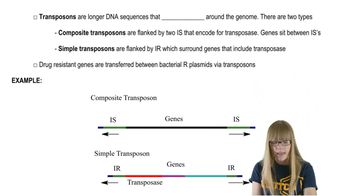
Transposition is the process by which a transposable element, such as IS10, moves from one location in the genome to another. This process is mediated by the enzyme transposase, which is produced in response to the transcription of the transposase gene. The efficiency of transposition is directly linked to the levels of transposase and the regulatory mechanisms controlling its expression.
추천 영상:
가이드 코스
06:10
Prokaryotic Transposable Elements
관련 실천
교과서 질문

How would mutations that inactivate each of the following genes affect the determination of the lytic or lysogenic life cycle in mutated λ phage strains? Explain your answers.

int

393
views
교과서 질문

For an E. coli strain with the lac operon genotype I⁺ P⁺ O⁺ Z⁺ Y⁺, identify the level of transcription of the operon genes in each growth medium listed. Specify transcription as 'none,' 'basal,' or 'activated' for each medium, and provide an explanation to justify your answer.

Growth medium contains glucose but no lactose.

845
views
교과서 질문

How would mutations that inactivate each of the following genes affect the determination of the lytic or lysogenic life cycle in mutated λ phage strains? Explain your answers.

cII and cro

446
views
교과서 질문

The bacterial insertion sequence IS10 uses antisense RNA to regulate translation of the mRNA that produces the enzyme transposase, which is required for insertion sequence transposition. Transcription of the antisense RNA gene is controlled by POUT, which is more than 10 times more efficient at transcription than the PIN promoter, which controls transposase gene transcription.

If a mutation of PIN eliminates its ability to function in transcription, what is the likely effect on the transposition of IS10?

453
views
교과서 질문

How would mutations that inactivate each of the following genes affect the determination of the lytic or lysogenic life cycle in mutated λ phage strains? Explain your answers.

N

354
views
교과서 질문

For an E. coli strain with the lac operon genotype I⁺ P⁺ O⁺ Z⁺ Y⁺, identify the level of transcription of the operon genes in each growth medium listed. Specify transcription as 'none,' 'basal,' or 'activated' for each medium, and provide an explanation to justify your answer.

Growth medium contains lactose and glucose.

828
views