Ch. 12 - Regulation of Gene Expression in Bacteria and Bacteriophage
Sanders - Genetic Analysis: An Integrated Approach 3rd Edition
Sanders3rd EditionGenetic Analysis: An Integrated ApproachISBN: 9780135564172당신이 사용하는 게 아니라요?교과서 변경
12장, 문제 10

How would a cap⁻ mutation that produces an inactive CAP protein affect transcriptional control of the lac operon?

검증된 단계별 안내
1
Understand the role of the CAP protein in the lac operon: CAP (catabolite activator protein) is a regulatory protein that facilitates the binding of RNA polymerase to the promoter of the lac operon, enhancing transcription. CAP requires cAMP to bind to the DNA at the CAP site.
Recognize the impact of a cap⁻ mutation: A cap⁻ mutation results in an inactive CAP protein. This means that CAP cannot bind to the CAP site on the DNA, even in the presence of cAMP.
Analyze the effect on transcription: Without CAP binding, RNA polymerase has difficulty binding efficiently to the promoter of the lac operon. This leads to reduced transcription of the operon, even when lactose is present and glucose levels are low.
Consider the physiological context: The lac operon is normally activated when glucose is scarce and lactose is available. The cap⁻ mutation disrupts this regulatory mechanism, leading to poor expression of the lac operon regardless of glucose levels.
Conclude the overall effect: The cap⁻ mutation results in a significant reduction in the transcriptional activation of the lac operon, impairing the cell's ability to metabolize lactose efficiently under conditions where it would normally do so.

비슷한 문제에 대한 검증된 영상 답변:

이 영상 해법은 위 문제에 도움이 된다고 튜터들이 추천한 것입니다.
영상 길이:
4m
도움이 되었나요?

주요 개념

질문에 올바르게 답하기 위해 반드시 이해해야 하는 핵심 개념들은 다음과 같습니다.

CAP Protein Function

The CAP (catabolite activator protein) is a transcription factor that enhances the expression of certain genes, including the lac operon, in response to low glucose levels. When glucose is scarce, CAP binds to cyclic AMP (cAMP), forming a complex that promotes RNA polymerase binding to the promoter of the lac operon, facilitating transcription.
추천 영상:

Lac Operon Structure

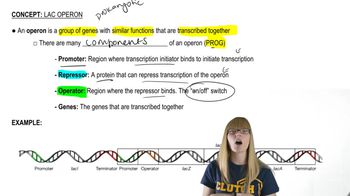
The lac operon is a set of genes in E. coli that are involved in the metabolism of lactose. It consists of three structural genes (lacZ, lacY, and lacA) and regulatory elements, including the promoter and operator. The operon is typically off when glucose is present but can be activated in the absence of glucose, allowing the bacteria to utilize lactose as an energy source.
추천 영상:
가이드 코스
04:27
Lac Operon Overview

Transcriptional Control Mechanisms

Transcriptional control mechanisms regulate gene expression in response to environmental changes. In the case of the lac operon, the presence of glucose inhibits cAMP production, leading to reduced CAP-cAMP complex formation. A cap⁻ mutation that produces an inactive CAP protein would prevent this activation, resulting in decreased transcription of the lac operon, even when lactose is available.
추천 영상:
가이드 코스
09:16
Eukaryotic Transcription
관련 실천
교과서 질문

The CAP binding site in the lac promoter is the location of positive regulation of gene expression for the operon. Identify what binds at this site to produce positive regulation, under what circumstances binding occurs, and how binding exerts a positive effect.

654
views
교과서 질문

Consider the transcription of genes of the lac operon under two conditions: (1) when both glucose and lactose are present and (2) when glucose is absent and lactose is present. Describe the comparative levels of transcription of lac operon genes under these conditions, and explain the molecular basis for the difference.

812
views
교과서 질문

What role does cAMP play in transcription of lac operon genes? What role does CAP play in transcription of lac operon genes?

1076
views
교과서 질문

Describe the lytic and lysogenic life cycles of λ bacteriophage. What roles do λ repressor and Cro protein play in controlling transcription from PR and PRM, and how are these roles linked to lysis and lysogeny?

644
views
교과서 질문

Explain the circumstances under which attenuation of operon gene expression is advantageous to a bacterial organism. Would you expect attenuation to be found in a single-celled eukaryote? In a multicelled eukaryote?

510
views
교과서 질문

The trpL region contains four repeated DNA sequences that lead to the formation of stem-loop structures in mRNA. What are these stem-loop structures, and how do they affect transcription of the structural genes of the trp operon?

530
views