Compare and contrast promoters and enhancers with respect to their location (upstream versus downstream), orientation, and distance (in base pairs) relative to a gene they regulate.
Ch. 13 - Regulation of Gene Expression in Eukaryotes

13장, 문제 13
Define epigenetics, and provide examples illustrating your definition.
검증된 단계별 안내1
Epigenetics is the study of heritable changes in gene expression that do not involve alterations to the underlying DNA sequence. These changes can affect how genes are turned on or off without modifying the genetic code itself.
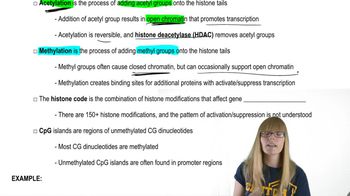
One example of epigenetics is DNA methylation, where methyl groups are added to the DNA molecule, typically at cytosine bases in CpG islands. This modification can suppress gene expression by preventing transcription factors from binding to the DNA.
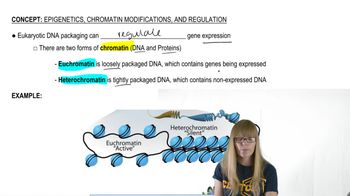
Another example is histone modification, where chemical groups such as acetyl, methyl, or phosphate groups are added to histone proteins. These modifications can alter the chromatin structure, making it either more open (euchromatin) or more condensed (heterochromatin), thereby influencing gene expression.
A third example is RNA-based mechanisms, such as non-coding RNAs (e.g., microRNAs) that can regulate gene expression post-transcriptionally by degrading mRNA or inhibiting its translation.
Epigenetic changes can be influenced by environmental factors such as diet, stress, and exposure to toxins, and they can sometimes be passed on to offspring, demonstrating their heritable nature.

비슷한 문제에 대한 검증된 영상 답변:
이 영상 해법은 위 문제에 도움이 된다고 튜터들이 추천한 것입니다.
영상 길이:
2m도움이 되었나요?
주요 개념
질문에 올바르게 답하기 위해 반드시 이해해야 하는 핵심 개념들은 다음과 같습니다.
Epigenetics
Epigenetics is the study of heritable changes in gene expression that do not involve alterations to the underlying DNA sequence. These changes can be influenced by various factors, including environmental conditions, lifestyle, and developmental stages. Epigenetic modifications, such as DNA methylation and histone modification, can activate or silence genes, thereby affecting how cells read the genetic code.
추천 영상:
가이드 코스
Chromatin
DNA Methylation
DNA methylation is a key epigenetic mechanism that involves the addition of a methyl group to the DNA molecule, typically at cytosine bases. This modification can inhibit gene expression by preventing the binding of transcription factors or recruiting proteins that compact the DNA, making it less accessible for transcription. For example, increased methylation of tumor suppressor genes can lead to their silencing, contributing to cancer development.
추천 영상:
가이드 코스
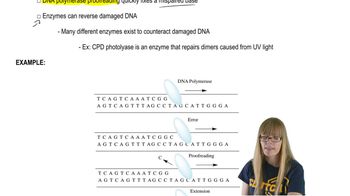
DNA Proofreading
Histone Modification
Histone modification refers to the chemical alterations of histone proteins around which DNA is wrapped, influencing gene accessibility and expression. Common modifications include acetylation, methylation, and phosphorylation, which can either promote or inhibit transcription. For instance, acetylation of histones generally leads to a more open chromatin structure, facilitating gene expression, while certain methylation patterns can lead to gene repression.
추천 영상:
가이드 코스
Histone Protein Modifications
관련 실천
교과서 질문
741
views
교과서 질문
What are the different chromatin classifications, and what is their relationship to gene expression?
628
views
교과서 질문
How does dsRNA lead to posttranscriptonal gene silencing?
814
views
교과서 질문
What is one proposed role for lncRNAs?
1075
views
교과서 질문
The term heterochromatin refers to heavily condensed regions of chromosomes that are largely devoid of genes. Since few genes exist there, these regions almost never decondense for transcription. At what point during the cell cycle would you expect to observe the decondensation of heterochromatic regions? Why?
498
views
교과서 질문
What are the sources of dsRNA? Diagram the mechanisms by which dsRNAs are produced and processed into small RNAs.
1066
views