Compare and contrast promoters and enhancers with respect to their location (upstream versus downstream), orientation, and distance (in base pairs) relative to a gene they regulate.
Ch. 13 - Regulation of Gene Expression in Eukaryotes

13장, 문제 12
What are the different chromatin classifications, and what is their relationship to gene expression?
검증된 단계별 안내1
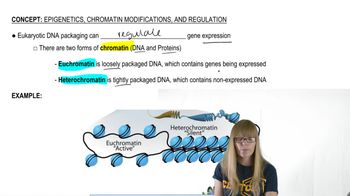
Understand that chromatin is the complex of DNA and proteins (mainly histones) that forms chromosomes within the nucleus of eukaryotic cells. Chromatin can be classified into two main types: euchromatin and heterochromatin.
Euchromatin is the less condensed form of chromatin. It is generally associated with active gene expression because the DNA is more accessible to transcription factors and RNA polymerase.
Heterochromatin is the more condensed form of chromatin. It is typically associated with gene silencing because the tightly packed structure makes the DNA less accessible to the transcriptional machinery.
Heterochromatin can be further divided into two subtypes: constitutive heterochromatin, which is always condensed and contains repetitive sequences (e.g., centromeres and telomeres), and facultative heterochromatin, which can switch between condensed and relaxed states depending on the cell's needs (e.g., the inactivated X chromosome in females).
The relationship between chromatin structure and gene expression is regulated by epigenetic modifications, such as DNA methylation and histone modifications. These modifications influence whether chromatin is in an open (euchromatin) or closed (heterochromatin) state, thereby controlling gene accessibility and expression.

비슷한 문제에 대한 검증된 영상 답변:
이 영상 해법은 위 문제에 도움이 된다고 튜터들이 추천한 것입니다.
영상 길이:
3m도움이 되었나요?
주요 개념
질문에 올바르게 답하기 위해 반드시 이해해야 하는 핵심 개념들은 다음과 같습니다.
Chromatin Structure
Chromatin is a complex of DNA and proteins that forms chromosomes within the nucleus of eukaryotic cells. It exists in two primary forms: euchromatin, which is loosely packed and associated with active gene expression, and heterochromatin, which is tightly packed and generally transcriptionally inactive. The structure of chromatin plays a crucial role in regulating access to DNA for transcription and replication.
추천 영상:
가이드 코스
Chromatin
Gene Expression Regulation
Gene expression regulation refers to the mechanisms that control the transcription of genes, determining when and how much of a gene product is produced. This regulation can be influenced by chromatin structure, where modifications such as methylation and acetylation can either promote or inhibit access to the DNA, thereby affecting the expression of nearby genes. Understanding these regulatory mechanisms is essential for comprehending how genes are turned on or off in response to various signals.
추천 영상:
가이드 코스
Penetrance and Expressivity
Epigenetics
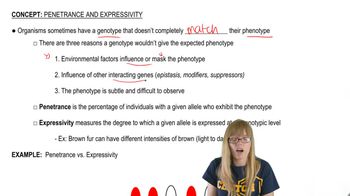
Epigenetics involves heritable changes in gene expression that do not involve alterations to the underlying DNA sequence. These changes can be influenced by environmental factors and can affect chromatin structure through chemical modifications. Epigenetic mechanisms, such as DNA methylation and histone modification, play a significant role in determining chromatin classifications and, consequently, the expression of genes, linking environmental influences to genetic outcomes.
추천 영상:
가이드 코스
Chromatin
관련 실천
교과서 질문
741
views
교과서 질문
Compare and contrast the transcriptional regulation of GAL genes in yeast with that of the lac genes in bacteria.
731
views
교과서 질문
Define epigenetics, and provide examples illustrating your definition.
974
views
교과서 질문
What is one proposed role for lncRNAs?
1075
views
교과서 질문
The term heterochromatin refers to heavily condensed regions of chromosomes that are largely devoid of genes. Since few genes exist there, these regions almost never decondense for transcription. At what point during the cell cycle would you expect to observe the decondensation of heterochromatic regions? Why?
498
views
교과서 질문
What are the sources of dsRNA? Diagram the mechanisms by which dsRNAs are produced and processed into small RNAs.
1066
views