Ch. 14 - Analysis of Gene Function via Forward Genetics and Reverse Genetics
Sanders - Genetic Analysis: An Integrated Approach 3rd Edition
Sanders3rd EditionGenetic Analysis: An Integrated ApproachISBN: 9780135564172당신이 사용하는 게 아니라요?교과서 변경
14장, 문제 19a

We designed a screen to identify conditional mutants of S. cerevisiae in which the secretory system was defective. Suppose we were successful in identifying 12 mutants.
Describe the crosses you would perform to determine the number of different genes represented by the 12 mutations.

검증된 단계별 안내
1
Step 1: Begin by crossing each of the 12 mutants with a wild-type strain of S. cerevisiae. This will ensure that the mutations are recessive and can be analyzed in subsequent steps. Observe the phenotypes of the resulting diploid strains to confirm that the secretory defect is recessive.
Step 2: Perform pairwise crosses between the 12 mutant strains to create diploid strains. For each cross, observe whether the diploid strain exhibits the mutant phenotype or the wild-type phenotype.
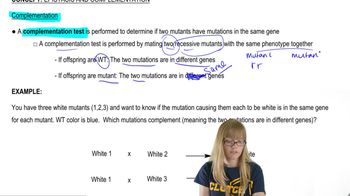
Step 3: Apply the concept of complementation testing. If two mutants complement each other (i.e., the diploid strain exhibits the wild-type phenotype), it indicates that the mutations are in different genes. If the diploid strain exhibits the mutant phenotype, the mutations are likely in the same gene.
Step 4: Organize the results of the complementation tests into groups based on which mutants complement each other. Each group represents a distinct gene involved in the secretory system.
Step 5: Count the number of groups formed from the complementation tests. This number represents the total number of different genes represented by the 12 mutations.

비슷한 문제에 대한 검증된 영상 답변:

이 영상 해법은 위 문제에 도움이 된다고 튜터들이 추천한 것입니다.
영상 길이:
2m
도움이 되었나요?

주요 개념

질문에 올바르게 답하기 위해 반드시 이해해야 하는 핵심 개념들은 다음과 같습니다.

Mutant Analysis

Mutant analysis involves studying organisms with specific mutations to understand gene function. In this context, identifying conditional mutants of S. cerevisiae helps researchers determine how these mutations affect the secretory system. By analyzing the phenotypes of these mutants, scientists can infer the roles of the affected genes.
추천 영상:
가이드 코스
02:48
Chi Square Analysis

Genetic Crosses

Genetic crosses are experimental breeding techniques used to study inheritance patterns and gene interactions. To determine the number of different genes represented by the 12 mutations, one would perform crosses between the mutants and analyze the offspring's phenotypes. This helps in identifying whether the mutations are in the same gene or in different genes.
추천 영상:
가이드 코스
26:08
Trihybrid Cross

Complementation Testing

Complementation testing is a method used to determine if two mutations that produce similar phenotypes are in the same gene or in different genes. By crossing two mutants and observing the phenotype of the offspring, researchers can assess whether the mutations complement each other (indicating different genes) or fail to complement (indicating the same gene). This is crucial for understanding the genetic basis of the identified mutants.
추천 영상:
가이드 코스
05:05
Complementation
관련 실천
교과서 질문

In humans, Duchenne muscular dystrophy is caused by a mutation in the dystrophin gene, which resides on the X chromosome. How would you create a mouse model of this genetic disease?

810
views
교과서 질문

In enhancer trapping experiments, a minimal promoter and a reporter gene are placed adjacent to the end of a transposon so that genomic enhancers adjacent to the insertion site can act to drive expression of the reporter gene. In a modification of this approach, a series of enhancers and a promoter can be placed at the end of a transposon so that transcription is activated from the transposon into adjacent genomic DNA. What types of mutations do you expect to be induced by such a transposon in a mutagenesis experiment?

634
views
교과서 질문

How would you perform a genetic screen to identify genes directing Drosophila wing development? Once you have a collection of wing-development mutants, how would you analyze your mutagenesis to learn how many genes are represented and how many alleles of each gene? How would you discover whether the genes act in the same or different pathways, and if in the same pathway, how do you discover the order in which they act? How would you clone the genes?

495
views
교과서 질문

How would you design a genetic screen to find genes involved in meiosis?

808
views
교과서 질문

We designed a screen to identify conditional mutants of S. cerevisiae in which the secretory system was defective. Suppose we were successful in identifying 12 mutants.

Based on your knowledge of the genetic tools for studying baker's yeast, how would you clone the genes that are mutated in your respective yeast strains? What is an approach to cloning the human orthologs of the yeast genes?

485
views
교과서 질문

The eyes of Drosophila develop from imaginal discs, groups of cells set aside in the fly embryo that differentiate into the adult structures during the pupal stage. Despite their importance in nature, eyes are dispensable for fruit fly life in the laboratory.

Devise a genetic screen to identify genes directing the development of the fly eye.

466
views