Ch. 15 - Recombinant DNA Technology and Its Applications
Sanders - Genetic Analysis: An Integrated Approach 3rd Edition
Sanders3rd EditionGenetic Analysis: An Integrated ApproachISBN: 9780135564172당신이 사용하는 게 아니라요?교과서 변경
15장, 문제 5a

Using the genomic libraries, you wish to clone the human gene encoding myostatin, which is expressed only in muscle cells.
Assuming the human genome is 3x10⁹ bp and that the average insert size in the genomic libraries is 100 kb, how frequently will a clone representing myostatin be found in the genomic library made from muscle?

검증된 단계별 안내
1
Determine the total number of clones in the genomic library by dividing the size of the human genome by the average insert size. Use the formula: 3×109100000.
Simplify the calculation to find the total number of clones in the library. This will give you the total number of fragments the genome is divided into, based on the insert size.
Understand that myostatin is expressed only in muscle cells, but the genomic library is constructed from the entire genome. Therefore, the probability of finding a clone representing myostatin is proportional to the size of the myostatin gene relative to the total genome size.
Estimate the size of the myostatin gene (if not provided, assume a typical gene size, e.g., 10 kb). Then calculate the probability of a single clone containing the myostatin gene using the formula: size of myostatin genetotal genome size.
Multiply the probability of a single clone containing the myostatin gene by the total number of clones in the library to estimate how frequently a clone representing myostatin will be found.

비슷한 문제에 대한 검증된 영상 답변:

이 영상 해법은 위 문제에 도움이 된다고 튜터들이 추천한 것입니다.
영상 길이:
3m
도움이 되었나요?

주요 개념

질문에 올바르게 답하기 위해 반드시 이해해야 하는 핵심 개념들은 다음과 같습니다.

Genomic Libraries

Genomic libraries are collections of DNA fragments that represent the entire genome of an organism. These libraries are created by cloning DNA into vectors, allowing researchers to isolate and study specific genes. Each clone in the library contains a fragment of the genome, and the size of these fragments can vary, impacting the likelihood of finding a specific gene, such as myostatin.
추천 영상:
가이드 코스
02:48
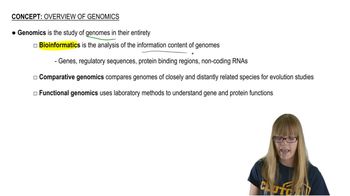
Genomics Overview

Gene Cloning

Gene cloning is the process of making multiple copies of a specific gene or DNA sequence. This involves inserting the gene of interest into a vector, which is then introduced into a host cell, allowing for replication. In this context, cloning the myostatin gene requires understanding its sequence and ensuring it is expressed in muscle cells, where it is naturally found.
추천 영상:
가이드 코스
07:
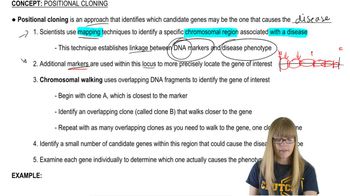
Positional Cloning

Insert Size and Frequency of Clones

The insert size in a genomic library refers to the average length of DNA fragments cloned into vectors. In this case, with an average insert size of 100 kb and a human genome size of approximately 3 billion base pairs, the frequency of finding a specific gene like myostatin can be estimated. The larger the insert size, the fewer clones are needed to cover the entire genome, affecting the probability of encountering the desired gene.
추천 영상:
가이드 코스
07:
Positional Cloning
관련 실천
교과서 질문

You have constructed four different libraries: a genomic library made from DNA isolated from human brain tissue, a genomic library made from DNA isolated from human muscle tissue, a human brain cDNA library, and a human muscle cDNA library.

Which of these would have the greatest diversity of sequences?

833
views
교과서 질문

Using the genomic libraries, you wish to clone the human gene encoding myostatin, which is expressed only in muscle cells.

How frequently will a clone representing myostatin be found in the cDNA library made from muscle?

517
views
교과서 질문

Using the genomic libraries, you wish to clone the human gene encoding myostatin, which is expressed only in muscle cells.

How frequently will a clone representing myostatin be found in the genomic library made from brain?

504
views
교과서 질문

Explain the meaning of 'identity by descent' in the context of identifying genealogical relationship between individuals. In these analyses, why are segments of chromosomes (haplotypes) rather than individual STRs used to identify genetic relationships?

668
views
교과서 질문

You have constructed four different libraries: a genomic library made from DNA isolated from human brain tissue, a genomic library made from DNA isolated from human muscle tissue, a human brain cDNA library, and a human muscle cDNA library.

Would the sequences contained in each library be expected to overlap completely, partially, or not at all with the sequences present in each of the other libraries?

517
views
교과서 질문

Using the genomic libraries, you wish to clone the human gene encoding myostatin, which is expressed only in muscle cells.

How frequently will a clone representing myostatin be found in the cDNA library made from brain?

578
views